

Last Updated: November 6, 2026
Quick Summary
Yes, you can store hay in a metal building safely if you control moisture, airflow and fire risk. Test bales for moisture before storage, keep the building well ventilated to prevent condensation, and stack bales with clearance for air movement and access.
- Test the center of every bale with a hay moisture meter, taking three or more readings.
- As a common guideline, square bales should be around 15% moisture or below before storage.
- Use ridge or eave vents so warm, moist air can escape and condensation does not drip onto bales.
- Keep at least 18 inches of clearance from walls and light fixtures when stacking.
- Probe bale centers regularly with a thermometer, since hay can self-heat and start a fire.
Table of Contents
- Step 1: Test Bale Moisture Before Storage
- Step 2: Prepare the Building and Floor
- Step 3: Manage Ventilation and Condensation
- Step 4: Stack Bales for Airflow, Clearance and Safe Access
- Step 5: Reduce Fire Risk From Hay Self-Heating
- Matching Your Metal Hay Barn Kit or Shed Design
- Booking Your Hay Storage Building Quote
- Frequently Asked Questions
Yes, you can store hay in a metal building safely, but only if you control moisture, airflow and fire risk. The same principles apply whether you are building new or using an existing structure. Hay stored too wet, packed too tightly or left without airflow can heat, mold and lose quality fast.
Most hay problems start before the bales ever reach the building. The steps below walk through moisture testing, preparing the space, managing ventilation and condensation, stacking for airflow and safe access, and reducing fire risk. Metal buildings can keep out rain, snow and direct sun, but they also trap heat and moisture if you skip the basics.
Step 1: Test Bale Moisture Before Storage
Test every bale before it goes into the building. Wet hay is the single biggest cause of spoilage and fire in storage, and a moisture meter is the only reliable way to know what you are loading.
Use a probe-type moisture meter designed for hay. Push the probe into the center of the bale, not the outside edge, because the outer inches dry faster and can read misleadingly low. Take at least three readings per bale from different sides, and test several bales from each load, field, or cutting. Do not rely on the top bales alone; moisture varies by position in the windrow and by bale density.
- Test the center of the bale, not the outside edge
- Take three or more readings per bale from different sides
- Check several bales from each field or cutting
- Record readings by load so you can track problem hay
- Retest any bale that feels warm or smells sour
Safe Moisture Thresholds for Hay
As a common guideline, square bales should be dry, around 15% moisture or below, before storage. Bales with higher moisture are at much greater risk of heating and mold. Confirm current moisture recommendations for your bale type and climate with your state extension office, because guidance varies.
Interpret readings by bale type and storage conditions. A reading of 16% in a small square bale stored in a dry, ventilated barn may be manageable, but the same reading in a dense round bale in a humid climate is a red flag. If readings are borderline, do not store the bale; feed it first or allow it to dry further under cover with airflow.
Watch out: A meter that is not calibrated or a probe that does not reach the center will give false confidence. Check your meter against a known dry bale or follow the manufacturer's calibration steps before relying on it.
Before loading, check moisture against these key readings and limits from the article.
| Check | Value | Note |
|---|---|---|
| Target moisture for square bales | 15% or below | Common guideline; confirm with extension office |
| Readings per bale | 3 or more | Take from different sides |
| Probe depth | Center of bale | Outer inches can read misleadingly low |
| Borderline readings | Do not store | Feed first or dry under cover |
Step 2: Prepare the Building and Floor
Start with a clean, dry, empty building. Old feed, manure and spilled grain attract pests and hold moisture against the floor.
Ground moisture is a common problem. Lay down a vapor barrier or raise the bales on pallets or a clean gravel base so air can move under them.
- Sweep out old debris and droppings
- Fix any leaks in the roof or walls before loading
- Lay a moisture barrier or use pallets under the bales
- Keep the floor drained so water does not pool
Step 3: Manage Ventilation and Condensation
Metal buildings are prone to condensation. Warm, humid air from the hay rises, hits the cold metal roof and drips back onto the bales.
Good airflow carries that moisture out. Use ridge vents, gable vents or open doors and windows to keep air moving through the building.
- Install ridge or eave vents to let warm, moist air escape
- Keep doors open on dry, breezy days to refresh the air
- Leave space between the bales and the walls
- Watch for dripping from the roof panels after cold nights
A common mistake is sealing a metal building tight to keep out pests. That traps moisture and turns a safe storage space into a mold problem.
Step 4: Stack Bales for Airflow, Clearance and Safe Access
Stack bales so air can move between them and so you can reach every row. Solid, tightly packed stacks hold heat in the center where you cannot see it.
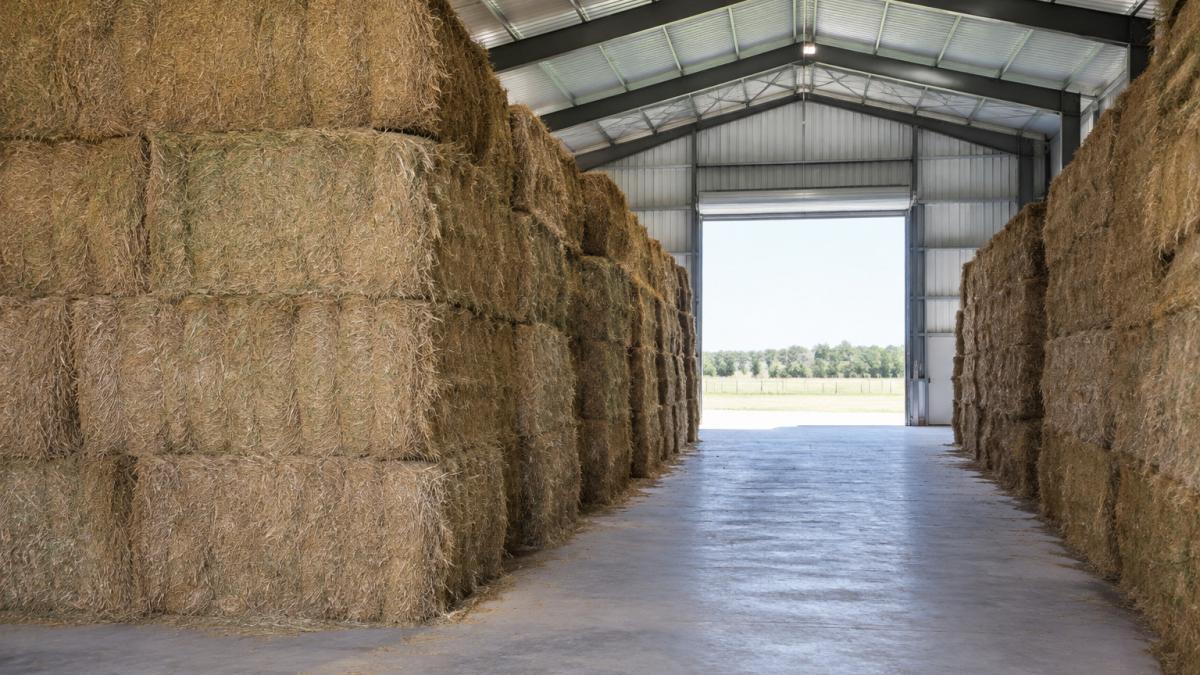
Leave clear aisles so you can inspect bales and get equipment in and out. Keep stacks away from the walls and from any electrical fixtures.
- Keep at least 18 inches of clearance from walls and light fixtures
- Stack in rows with aisles wide enough for your equipment
- Do not stack bales so high that the top touches the roof
- Stagger bales so air can pass through the stack
Check the owner's manual of your building and your insurance policy for any limits on stack height or clearance. Some insurers set their own requirements.
Step 5: Reduce Fire Risk From Hay Self-Heating
Hay can self-heat when moisture and biological activity build up inside the bales (Preventing Fires in Baled Hay and Straw). Bacteria and fungi consume plant sugars and release heat, and in a tightly packed stack that heat cannot escape. Temperatures can climb high enough to start a fire without any spark. This is a key safety risk, and it is the reason moisture testing and airflow matter so much.
Check bales regularly with a probe thermometer designed for hay. Insert the probe into the center of several bales in different parts of the stack, especially the middle and lower rows where heat accumulates. Readings well above ambient temperature are warning signs. Check stacks regularly, especially during the first months after storage and after any warm, humid spell.
- Check stacks at least weekly during the first months after storage
- Probe the center of bales in the middle and lower rows
- Record temperatures so you can spot a rising trend
- Watch for steam, smoke, a sweet or sour smell, or condensation on the roof
- Keep a fire extinguisher and water source nearby
- Never store hay near heaters, wiring or vehicles with open flames
If you find heating you cannot control, call your local fire department. Do not move hot hay through a building or into a vehicle, because introducing air can cause a flare-up. Many fire departments can advise on safe access to your building and what they need from you before a problem happens.
Watch out: A single hot bale can ignite surrounding hay, and smoke may not be visible from outside a closed metal building. Rely on temperature readings and smell, not just a visual check.
Matching Your Metal Hay Barn Kit or Shed Design
Choosing the right building matters as much as how you store the hay. Size the structure for the bales you plan to keep, plus room for aisles and equipment.
For a double-truss option that gives generous interior height and width, the Gold Mountain 40' × 80' × 21' Double-Truss Storage Shelter with 8' Truss Spacing offers about 3,200 square feet of covered space at $17,900.00. If you are weighing building styles first, single-truss vs double-truss arch storage shelters explains how the frame affects interior clearance. For sizing guidance, see how to choose the right size storage shelter for farm equipment.

Keep in mind that a larger building still needs the same ventilation and clearance practices described above. Plan vent placement before the walls go up.
Booking Your Hay Storage Building Quote
Once you know the size and layout you need, request a written quote so you can compare costs clearly. Flint Hills Barns provides personalized quote help and confirms availability for your ZIP code before you commit.
If you are ready to move forward, get a quote for a custom barn in 7 steps walks you through what to prepare. You can also review metal building suppliers with transparent written quotes to know what to ask for.
Request personal quote help from Flint Hills Barns to plan a storage building that fits your hay, your equipment and your land.
Frequently Asked Questions
How long can you store hay in a metal building safely?
Hay stored in a metal building can keep its quality for many months when bales are dry, usually tested at or below about 15 percent moisture, and the building is well ventilated and kept free of leaks. Check stored bales regularly for heat, mold odor and damp spots, especially during the first few weeks after storage and after weather changes. If bales feel warm or smell musty, remove them and inspect the stack before the problem spreads.
How do you prevent moisture and condensation in a metal hay barn?
Start with dry bales and a building that ventilates at the ridge and eaves so moist air can leave. Avoid storing hay directly on bare ground, keep a gap between stacks and walls, and insulate or use vapor-controlled roof panels where warm, humid air meets cold metal. Condensation tends to form on the underside of metal roofs overnight, so watch for drips after temperature swings and address them quickly.
Can hay catch fire while stored in a barn?
Yes. Hay that is stored too wet can self-heat as microbes break down the crop, and temperatures can rise high enough to cause ignition. Keep bales dry at harvest, avoid stacking very fresh or damp hay, leave clearance from heat sources and electrical equipment, and check stacks periodically with a thermometer probe. Consider contacting your local fire department about access and any requirements for your building.
How should hay bales be stacked in a metal building?
Stack bales in a way that keeps air moving between them and lets you reach every row. Leave aisle space and a gap from the walls, avoid building stacks higher than you can safely access, and keep the floor covered with pallets or a moisture barrier. Rotate older bales forward so the oldest hay is used first.
