

Last Updated: November 5, 2026
Quick Summary
Good metal garage ventilation pairs low intake vents with high exhaust vents, such as ridge or gable vents, so warm, moist air can escape and fresh air can enter. Aim to replace the building's full air volume several times per hour, and add a fan or dehumidifier if humidity stays high. Monitor humidity with hygrometers to protect stored equipment from rust and mold.
- Five to six air changes per hour is a common starting point for storage garages.
- Place intake vents at the eaves or lower walls and exhaust vents at the ridge or gable ends.
- Keep indoor humidity below about 60 percent to reduce rust and condensation risk.
- Never run gas-powered equipment in an enclosed garage without strong, dedicated exhaust.
Table of Contents
- Why Ventilation Matters for Equipment in a Metal Garage
- Step 1: Measure the Building and Set Your Airflow Target
- Step 2: Choose Passive Vents: Roof Vents and Gable Vents for Metal Buildings
- Step 3: Decide Whether a Metal Building Ventilation Fan Is Needed
- Step 4: Place Intake and Exhaust Vents So Air Actually Moves
- Step 5: Control Humidity, Condensation, and Rust Through the Seasons
- Common Mistakes When Ventilating a Metal Garage
- Planning Your Ventilation Setup With Flint Hills Barns
- Frequently Asked Questions
Why Ventilation Matters for Equipment in a Metal Garage
A metal garage heats up fast in summer and collects moisture in winter, so good metal garage ventilation matters year-round.
Proper metal garage ventilation solves most of these issues. Moving air carries away trapped heat and moisture before they settle on your machines.
The OSHA guidance on indoor air quality in enclosed workspaces explains why enclosed buildings need a steady supply of fresh air.
Here is what good ventilation helps you prevent:
- Rust on metal tools, hitches, and equipment frames
- Condensation dripping onto stored machinery
- Mold and mildew on cushions, belts, and fabric covers
Step 1: Measure the Building and Set Your Airflow Target
Start by measuring the length, width, and peak height of your garage. Those numbers tell you how much air the space holds. You also need to know how much equipment sits inside, because bulky machines block airflow.
Next, pick a rough airflow goal. Many people aim to replace the full volume of air in the building several times per hour.
A Simple Sizing Method for Your Garage
Use this quick method to estimate what you need:
- Multiply length × width × average height to get the cubic feet of air.
- Decide how many times per hour you want that air replaced. Five to six air changes per hour is a common starting point for storage.
- Multiply cubic feet by air changes per hour to get your target cubic feet per minute (CFM). Divide by 60.
For a 30' × 60' × 20' building, that's 36,000 cubic feet. Five air changes per hour works out to about 3,000 CFM. Our guide to choosing the right size storage shelter for farm equipment can help you match building dimensions to your machines.
The sizing method below turns your garage's dimensions into a target airflow, using the example of a 30' × 60' × 20' building.
| Step | What to do | Time or frequency |
|---|---|---|
| Measure length, width, and height | Multiply length × width × average height for cubic feet | Once, before buying equipment |
| Pick air changes per hour | Five to six is a common starting point for storage | Adjust for climate and door use |
| Calculate target CFM | Cubic feet × air changes per hour ÷ 60 | Once per building |
| Check the example | 36,000 cubic feet at five changes per hour ≈ 3,000 CFM | Use as a reference |
Step 2: Choose Passive Vents: Roof Vents and Gable Vents for Metal Buildings
Passive vents move air without electricity. They work by letting warm air rise and escape while cooler air enters lower down.
The two most common options are roof vents and gable vents:
- Ridge vents run along the peak of the roof and let hot air escape from the top.
- Gable vents sit in the end walls and work well when wind blows across the building.
Pair them with intake vents at the eaves or lower walls so air has somewhere to come in.
Watch out: blocking the intake vents with stored equipment or stacked feed will stop airflow entirely, even when the exhaust vents are clear.
Step 3: Decide Whether a Metal Building Ventilation Fan Is Needed
A metal building ventilation fan is worth considering if your garage gets very hot, stays humid, or holds fuel and fumes. Fans push air through the building faster than passive vents can on their own.
Consider a fan when:
- You store machines that sweat or collect condensation
- The building gets above 100°F in summer
- You work inside the garage while equipment runs
Keep in mind that a fan only helps if fresh air can come in. Size the fan to your airflow target from Step 1, and make sure intake vents or open doors allow air to replace what the fan removes.
Step 4: Place Intake and Exhaust Vents So Air Actually Moves
Vent placement matters as much as vent size. Air follows the path of least resistance, so you want intake vents low on the building and exhaust vents high. This setup lets warm air rise out while cool air enters below.
10' × 20' Plus Metal Garage Shed with Double Front Doors & Side Entry →
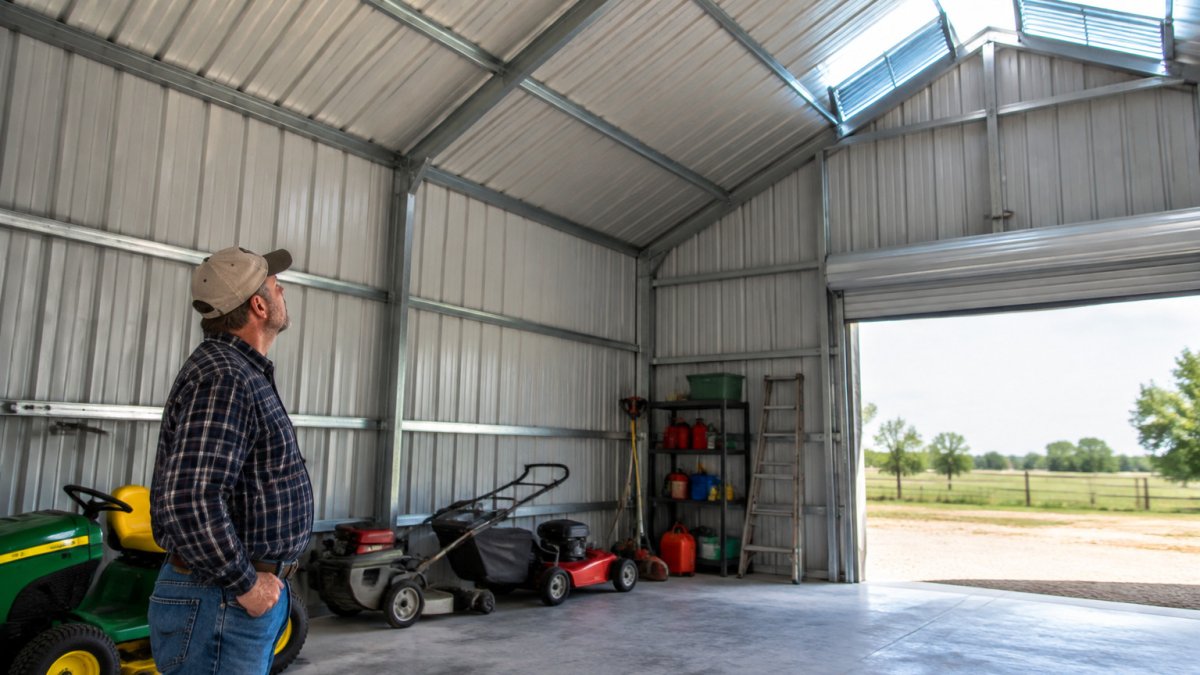
Follow these placement rules:
- Put intake vents at the eaves, soffits, or lower side walls.
- Put exhaust vents at the ridge or high in the gable ends.
- Spread vents evenly so air doesn't stall in one corner.
A common mistake is placing all the vents on one side. Air then moves across a single path and leaves the rest of the building stale.
Step 5: Control Humidity, Condensation, and Rust Through the Seasons
Humidity changes with the seasons, so your ventilation plan should change too. In winter, warm moist air from machines and people meets cold metal roof panels and condenses. Summer brings heat and humidity that can cause rust on bare steel. The key is to monitor actual conditions rather than guess, then decide whether airflow alone is enough or whether you need mechanical moisture removal.
Set a Humidity Target and Place Sensors Correctly
Most equipment storage benefits from keeping indoor relative humidity below about 60 percent; above 70 percent, bare steel, cast iron, and electronics are at meaningful risk of condensation and corrosion. A common pattern is to aim for 45-55 percent in heated or semi-conditioned spaces and never let the building sit above 65 percent for extended periods.
Place at least two hygrometers: one at equipment height (about 4-5 feet off the floor) near the center of the building, and one near the coldest surface, typically the north wall or under the roof deck where condensation forms first. Avoid placing sensors directly above doors, near vents, or in direct sun, because those readings will mislead you. For more on managing cold-weather condensation, see metal building insulation for winter.
Decide Between Ventilation and Dehumidification
Use this decision process:
- If indoor humidity is below 60 percent and surfaces are dry, passive or fan ventilation is sufficient.
- If indoor humidity is 60-70 percent and outdoor dew point is lower than indoor dew point, run exhaust fans or open vents to exchange air.
- If indoor humidity stays above 70 percent for more than a day, or if condensation appears on equipment or the roof deck, add a dehumidifier sized to the building volume.
- If outdoor humidity is higher than indoor (common in hot-humid summer afternoons), do not ventilate, close vents and run the dehumidifier instead.
A desiccant or refrigerant dehumidifier sized at roughly 1 pint per 1,000 cubic feet per day is a reasonable starting point for storage spaces; adjust based on your hygrometer readings. Run it on a humidistat set to 55-60 percent so it cycles only when needed.
Equipment-Specific Moisture Risks
Different equipment fails in different ways, so tailor your controls:
- Bare steel and cast iron (tractors, implements, hitches): condensation forms when humid air meets cold metal. Keep surfaces above the dew point by maintaining airflow and, where practical, applying a corrosion inhibitor or light oil film. Learn how metal structure durability in the Midwest holds up against rust and moisture over time.
- Power tools and electronics: circuit boards and motors are sensitive to sustained humidity above 65 percent. Store them in sealed cases with desiccant packs and keep the building below 60 percent.
- Fuel-powered equipment (mowers, generators, chainsaws): fuel systems attract moisture and ethanol-blended fuel can phase-separate. Store with stabilized fuel, keep tanks full to reduce airspace, and ventilate to prevent fume accumulation.
Seasonal Adjustments
- Winter: run ventilation during the coldest months to remove moist air, but avoid pulling in cold, damp outside air when indoor surfaces are already near freezing, that accelerates condensation. Ventilate during the warmest part of the day.
- Spring and fall: these shoulder seasons bring wide temperature swings and are the highest-risk periods for condensation on metal panels. Keep fans on a timer or humidistat and inspect the roof deck weekly.
- Summer: ventilate in the early morning when outdoor dew point is lowest; close up during hot-humid afternoons and rely on dehumidification.
Wipe down equipment after wet use before storing it, check seals and vent covers each spring and fall, and log hygrometer readings so you can spot trends before rust appears.
For more detail on winter moisture control, read our Metal Building Insulation for Winter: 2026 Guide | flinthillsbarns.com and the Metal Structure Durability in Midwest: 2026 Guide | flinthillsbarns.com.
Common Mistakes When Ventilating a Metal Garage
Most ventilation problems come from a few predictable errors. Fixing them is cheaper than repairing rusted equipment or dealing with a safety incident.
- Installing exhaust vents without intake vents. Air cannot leave a sealed box. Every exhaust fan or ridge vent needs a matched intake area, typically at least as much free intake area as exhaust area, or the fan will starve and airflow will stall.
- Sizing the fan too small for the building's volume. A fan rated for a small shop will not move enough air in a 36,000-cubic-foot garage. Match CFM to your air-change target from Step 1.
- Storing equipment directly under vents. Blocked intakes and exhausts stop airflow entirely. Keep a clear zone of at least 2 feet around every vent.
Combustion Safety and Fumes
Carbon monoxide from running engines is a serious hazard. Never run gas equipment in an enclosed garage without strong, dedicated exhaust. The CDC carbon monoxide safety guidance explains the warning signs and safe practices. A few rules matter more than any vent layout:
- Combustion air: any fuel-burning appliance or engine needs a supply of fresh air for complete combustion. A tightly sealed metal garage with exhaust fans can depressurize the space and back-draft combustion appliances. Provide dedicated combustion-air openings or keep a door cracked when running engines briefly.
- Source capture beats dilution: general ventilation dilutes fumes but does not remove them at the source. For welding, solvent use, or running engines, use a local exhaust hood or flexible duct that captures contaminants at the point of generation and discharges outdoors.
- Never discharge exhaust into the building. Route generator and engine exhaust through a hose or duct to the outside, and keep the discharge away from intake vents.
Airflow and Placement Mistakes
- Placing all vents on one side. Air then moves across a single path and leaves the rest of the building stale. Spread intake and exhaust across opposite sides and along the ridge.
- Putting exhaust low and intake high. Warm air rises, so exhaust belongs high and intake low. Reversing them fights physics.
- Sealing the building too tightly without planning ventilation. Air sealing and vapor barriers improve moisture control, but a sealed metal building needs a deliberate ventilation path. Coordinate insulation, vapor barriers, and vent placement so you do not trap moisture against cold surfaces.
Planning Your Ventilation Setup With Flint Hills Barns
A good ventilation plan starts with the right building. At Flint Hills Barns, we help rural property owners and farmers plan custom metal structures for equipment storage, including layouts that account for airflow, door placement, and vent options. You can also review financing options through Synchrony for barns, garages, and storage buildings.
You can also [page:3] to explore a 13' × 20' storage shed as a smaller option for tools and lawn equipment.
Frequently Asked Questions
What is the most affordable way to ventilate a garage?
The lowest-cost approach is usually passive ventilation: adding intake vents low on the walls or eaves and exhaust vents high on the roof or gable ends so warm, humid air can rise and leave on its own. Wall vents, such as the four included on Flint Hills Barns' 10' x 20' sheds, are a practical starting point. Passive vents require no electricity and little maintenance. A powered exhaust fan adds cost and wiring, so it is generally worth adding only when passive airflow cannot keep humidity down, especially in a tightly sealed or heavily used building.
Are ridge vents or gable vents better for a metal garage?
Ridge vents run along the peak of the roof and exhaust warm air across the entire length of the building, which makes them effective for continuous airflow. Gable vents sit in the end walls and work best when paired with intake vents on the opposite end to create cross-ventilation. For many equipment storage garages, a combination works best: low intake vents with a ridge or high gable exhaust. Choose based on building length, roof style, and where you can place intake openings without exposing equipment to blowing rain.
How can you reduce condensation in a metal garage during winter?
Condensation forms when warm, humid interior air hits cold metal roof panels. To reduce it in winter, keep some airflow moving through the building even when it is cold, using intake and exhaust vents sized for your garage. Avoid drying wet equipment or washing vehicles indoors without ventilating afterward. A basic hygrometer can show when humidity stays high for long periods, which is a signal to add vents or a small exhaust fan. Insulation and vapor barriers can also reduce condensation on the roof underside.
When should you use a powered ventilation fan in an equipment storage garage?
Consider a powered fan when passive vents cannot clear heat or humidity, when the garage is large or tightly sealed, or when you store equipment that is sensitive to moisture. Size the fan by the building's volume and the number of air changes per hour you want. Pair an exhaust fan with a low intake vent so the fan has air to pull through. Do not use fuel-burning equipment inside a garage without confirming that combustion exhaust is handled safely and that carbon monoxide risk is addressed.
