

Last Updated: October 25, 2026
Quick Summary
An arch storage shelter truss design choice depends on load capacity and budget: single-truss designs provide unobstructed interior space for vehicles and equipment on smaller properties, while double-truss construction adds structural support for heavier loads and larger spans essential for agricultural operations.
- Single-truss shelters span 20-30 feet with 12-15 foot peak height, starting at $2,298-$5,499 for general equipment storage.
- Double-truss shelters span 30-40 feet with 20-23 foot peak heights, starting at $19,999 for heavy equipment and bulk materials.
- Single-truss arches concentrate loads at two foundation points; double-truss systems distribute loads across more anchor plates for redundancy.
- Wind and snow ratings require site-specific verification with local building code and ASCE 7 standards, not catalog maximums alone.
- Double-truss frames include more anchor points, the 40' × 64' model uses 18 anchor plates, reducing settling risk over time.
Table of Contents
- Single-Truss vs Double-Truss Arch Storage Shelters: Quick Comparison
- How Single-Truss and Double-Truss Arch Shelters Differ Structurally
- Arch Storage Shelter Truss Spacing and Load Distribution
- Arch Shelter Wind and Snow Loads: Engineering Capacity
- Farm Equipment Storage Shelter: Which Design Handles Your Load
- Arch Shelter Foundation and Anchoring Requirements
- Cost, Span, and Usable Interior: The Real Trade-offs
- Request Your Custom Shelter Quote
- Frequently Asked Questions
Single-Truss vs Double-Truss Arch Storage Shelters: Quick Comparison
Choosing an arch storage shelter truss design comes down to what your building must handle and what you'll spend. Single-truss arch shelters create open interior spans without center columns, ideal for equipment and vehicle storage on smaller to mid-sized properties.
At Flint Hills Barns, we help farmers and ranchers across the Midwest and South weigh these trade-offs. The choice isn't just price: it's whether your application, livestock shelter, hay storage, or equipment staging, fits the load capacity, span, and clearance each design provides.
American Society of Civil Engineers guidance on metal building design
How Single-Truss and Double-Truss Arch Shelters Differ Structurally
A single-truss arch shelter uses one curved structural member spanning the full building width, distributing loads outward and downward to the foundation points at each end.
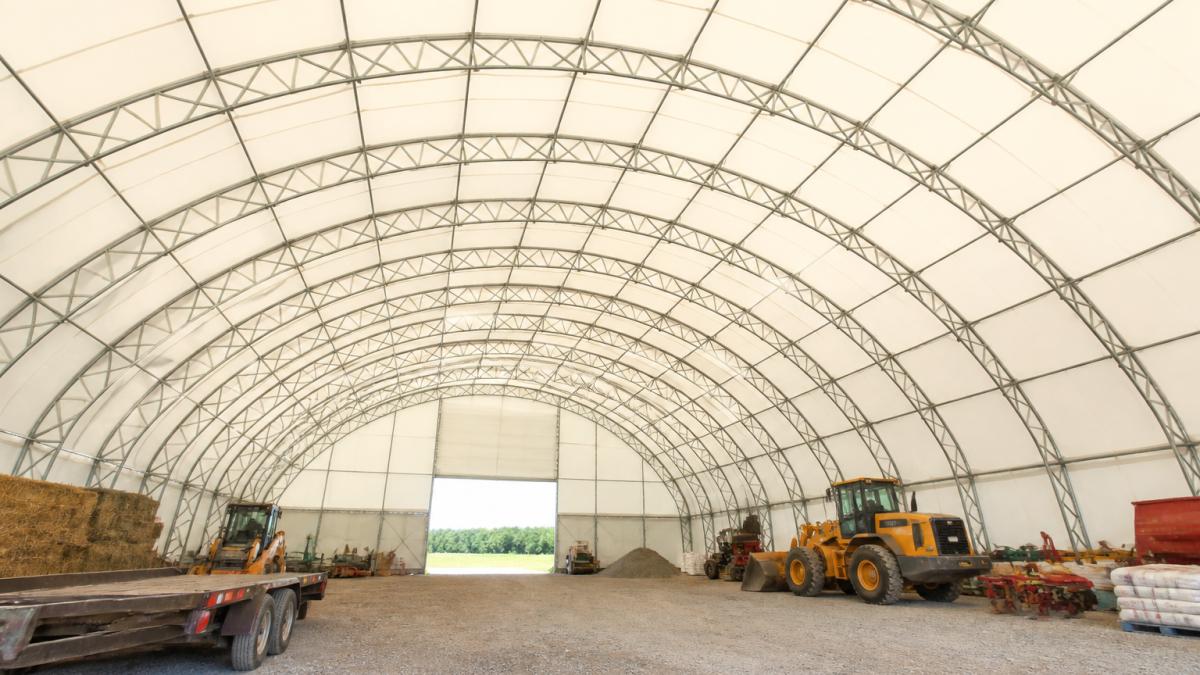
Double-truss construction adds a second parallel arch member, creating redundancy and significantly increasing structural capacity. The two arches share heavier concentrated loads, wider spans, and more severe weather, like two ropes sharing a weight instead of one.
The practical difference shows up in usable space.
Arch Storage Shelter Truss Spacing and Load Distribution
Truss spacing is the distance between individual arches along your building's length. Closer spacing increases rigidity and load capacity but raises material and labor costs.
Load distribution in a single-truss system concentrates along the two foundation points, where snow, rain, and stored materials push outward and downward. This handles lighter items, vehicles, tools, seasonal equipment, efficiently, but stacking heavy materials like cement bags or coal may exceed a single arch for your site's conditions.
Double-truss systems distribute loads across more structural material. The dual arches share the weight, so foundation requirements are often more manageable and concentrated loads, like a heavily loaded tractor parked in one spot, are handled without excessive deflection.
International Building Code standards for metal structure load calculations
Arch Shelter Wind and Snow Loads: Engineering Capacity
Wind and snow most often decide whether a single-truss frame is adequate or you need double-truss redundancy. What matters isn't the spec-sheet headline rating but how each frame carries loads to the ground and how building code translates your site conditions into a required design load.
How the loads travel. On a single-truss arch, wind and snow loads are resisted by the arch acting in compression, with reactions pushed outward and downward into the two foundation lines. That path is efficient for uniform loads but concentrates demand at the anchors and crown. A double-truss frame splits that demand between two parallel members tied by web or spacer members, so the same load produces less deflection per member and is shared across more anchor plates, tolerating a heavier point load, like a drifted snow pocket, without the visible sag of an overloaded single arch.
What the code actually requires. Metal arch shelters are typically engineered and permitted under the International Building Code (IBC), with structural provisions drawn from ASCE 7, Minimum Design Loads and Associated Criteria for Buildings and Other Structures, which defines ground snow load, wind speed, exposure category, and importance factor for a site. Two consequences matter:
- Ground snow load is site-specific. ASCE 7 snow loads are set by ground snow load for the location, then adjusted for roof exposure, thermal conditions, and, critically for arch roofs, unbalanced and drift cases. A curved roof sheds snow differently than a flat roof, but it can also trap snow on the leeward side or in valleys where a shelter abuts another structure. A manufacturer's flat psf rating does not automatically account for drift.
- Wind speed is a basic speed, not a gust you feel. The wind ratings quoted for arch shelters are usually allowable or design values tied to a basic wind speed map, not the peak gust on a stormy afternoon. Exposure category (open field versus suburban versus urban) changes the effective pressure substantially, which is why the same shelter can be adequate on one parcel and under-built on the next.
Reading the ratings realistically. A single-truss arch shelter is commonly listed around 60 mph wind and 30-40 psf snow, depending on span and spacing, adequate for many moderate-climate rural sites.
Matching the frame to your climate. Compare the manufacturer's listed capacity against the ASCE 7 ground snow load and basic wind speed for your site, then add margin for drift, exposure, and stored material. Where the numbers are close, the double-truss frame's redundancy and greater anchor count buy the margin you need; where they sit comfortably below the single-truss rating, single-truss is the economical choice. Flint Hills Barns confirms ZIP-code-specific availability and aligns engineering documents with your actual weather exposure rather than generic industry maximums.
ASCE 7 minimum design loads standard International Building Code structural provisions
Farm Equipment Storage Shelter: Which Design Handles Your Load
The decision comes down to what you're storing and how you use the space. Single-truss designs excel for general-purpose equipment storage: pickups, compact tractors, trailers, lawn equipment, and seasonal supplies.
Gold Mountain 20' × 30' × 12' Reinforced Single-Truss Storage Shelter →
For livestock shelter combined with equipment staging, or for bulk material storage (hay, feed, coal, cement), double-truss construction handles the repeated loading and unloading cycles.
Watch out: undersizing creates problems. A single-truss design sized for lighter loads will show visible deflection under heavy equipment or stacked materials, while oversizing adds unnecessary cost.
American Farm Bureau guidance on agricultural building selection
Arch Shelter Foundation and Anchoring Requirements
Both designs need solid foundations, but anchoring differs by load distribution.
Double-truss shelters distribute loads across more anchor points. The 40' × 64' × 23' double-truss model, for example, includes 18 anchor plates designed for a solid concrete foundation. More anchor points mean more even weight distribution and reduced risk of settling or movement over time.
Site prep is critical: verify underground utilities before breaking ground, choose a level, well-drained location with clearance for assembly and equipment movement, and confirm local code and permit requirements before installation.
Cost, Span, and Usable Interior: The Real Trade-offs
Sticker price is the easiest number to compare and the least useful for a decision that will stand for decades. The real trade-off is total cost of ownership: up-front price, foundation and installation, maintenance and repairs over the service life, and resale value.
Up-front price, in context. Single-truss shelters carry the lower purchase price because they use less steel and simpler engineering. The 30' × 65' × 15' Single-Truss Arch Storage Shelter at $5,499.00 delivers roughly 1,950 square feet for larger equipment yards or combined storage zones.

| Design | Typical Span | Peak Height | Best For | Starting Price |
|---|---|---|---|---|
| Single-Truss | 20-30 ft. | 12-15 ft. | Vehicles, compact equipment, seasonal storage | $2,298-$5,499 |
| Double-Truss | 30-40 ft. | 20-23 ft. | Heavy equipment, bulk materials, multi-use operations | $19,999+ |
The costs the sticker hides. A fair comparison adds four line items:
- Foundation and site prep. Both designs need a level, well-drained pad and anchoring, but the double-truss frame's greater anchor count (the 40' × 64' model lists 18 anchor plates) means more concrete, more drilling, and more inspection time. Budget for excavation, base material, and concrete separately from the shelter itself.
- Installation. Larger double-truss shelters usually warrant professional erection to get frame alignment, cover tension, and door operation right. That labor is a real cost and a real quality factor, a poorly tensioned cover or misaligned frame shortens service life.
- Maintenance and repairs. Both frame types need periodic inspection of anchors, fasteners, and cover tension. The double-truss frame's extra members and connections are more places to inspect, but its redundancy means a single damaged member is less likely to compromise the whole structure. Cover replacement is the largest recurring cost on either design and is driven by UV exposure and wind abrasion more than by truss count.
- Service life and resale. A frame that is properly engineered for its site and kept under tension tends to last longer and hold value better than one that is overloaded or under-anchored. The double-truss premium is partly a bet on a longer, lower-drama service life in a demanding application.
Span and usable interior. A single-truss shelter with a 30-foot width gives you the full 30 feet of clear floor space with no center columns.
Request a custom shelter quote to explore options matched to your specific footprint and equipment list. Bobby Payne provides personalized guidance on planning clearances, access points, and covered space to maximize usable area and total value for your operation.
Request Your Custom Shelter Quote
Choosing between single-truss and double-truss arch storage shelters requires honest assessment of your equipment, materials, weather exposure, and budget. Single-truss designs deliver excellent value for general-purpose storage and lighter loads; double-truss justifies its premium when you need the span, clearance, and load capacity for demanding agricultural or commercial operations.
Flint Hills Barns simplifies this decision with personalized quote assistance tailored to your specific needs. Keep your equipment and hay under cover with a custom shelter quote, we confirm ZIP-code specific availability through regional manufacturing partnerships and provide clear written quotes that account for your site conditions, local building codes, and operational requirements.
Frequently Asked Questions
What is the difference between a single-truss and double-truss arch storage shelter?
A single-truss arch shelter uses one curved structural member spanning the width, creating an unobstructed interior. A double-truss design uses two parallel arches, typically spaced 8 feet apart, reinforcing the frame for larger spans and heavier loads. Single-truss shelters work well for compact storage up to 30 feet wide; double-truss shelters handle 40+ feet and demanding agricultural or commercial use.
Which is stronger: a single-truss or double-truss arch shelter?
Double-truss shelters are structurally stronger. The dual-arch configuration distributes loads across two load paths instead of one, increasing the frame's ability to resist wind, snow, and equipment weight. The Gold Mountain 40' × 64' × 23' double-truss shelter is rated for 60 mph winds and 48 lb./sq. ft. snow load, making it suitable for demanding agricultural and commercial applications where a single-truss design would be undersized.
How far apart should trusses be spaced in an arch storage shelter?
The Gold Mountain double-truss shelter uses 8-foot arch spacing. Closer spacing increases structural rigidity and load capacity but raises material and cost. Your specific spacing depends on span width, expected snow and wind loads, and the shelter's intended use for farm equipment or bulk storage.
What factors affect the cost of a single- or double-truss shelter?
Cost is driven by span width, peak height, total footprint, truss configuration, and cover material. Single-truss shelters range from $2,299 (20' × 30') to $5,499 (30' × 65'). Double-truss shelters start at $19,999 for a 40' × 64' shelter with dual roll-up doors and heavy-duty frame. Larger spans, higher peaks, reinforced trusses, and premium fabric covers all increase price. Double-truss designs cost significantly more but deliver greater load capacity and durability for commercial or high-demand storage.
Which arch shelter design is better for storing farm equipment?
Single-truss shelters suit compact farm storage: tractors, trailers, and seasonal equipment in footprints up to 30' × 65'. Double-truss shelters excel for larger operations needing 40'+ width, dual drive-through access, and high clearance (23 feet) for combines, loaders, and stacked materials. The Gold Mountain double-truss shelter's 18' × 14' roll-up doors and 2,560 sq. ft. footprint handle heavy machinery and bulk material storage that would overwhelm a single-truss design.
