

Last Updated: November 9, 2026
Quick Summary
Container shelter panels for heavy snow are the fabric and framing components designed to carry snow weight without sagging or tearing, and their rating sets how much snow the roof can hold. Match that rating to your worst winter, not your average one. Ask for both snow and wind ratings in writing, along with their assumptions.
- Wet snow can weigh several times more than dry snow of the same depth.
- Ask whether a snow rating covers uniform load only or also drift and unbalanced cases.
- A wind rating depends on exposure, height, and whether end panels are installed.
- Check that shipping containers you plan to use are compatible with the shelter's mounting system.
- Have any used panel inspected by a qualified person before installing it over people or equipment.
Table of Contents
- Why Snow Load Is the Deciding Factor for Container Shelters
- How Snow Load Ratings and Wind Load Resistance Work Together
- Frame Construction, Steel Quality and Fabric Weight
- Shipping Container Compatibility and Mounting Methods
- 40ft Shipping Container Canopy Options and Sizing for Snow Country
- Container Shelter Panels for Heavy Snow Price and Used Panel Considerations
- Booking Your Heavy-Snow Shelter Quote With Flint Hills Barns
- Frequently Asked Questions
Why Snow Load Is the Deciding Factor for Container Shelters
Snow load is an important factor in whether a container shelter survives winter. A canopy that handles wind well can still collapse under a heavy, wet snowpack. Many buyers in the Midwest and South focus on price and size first, then learn about snow load after the order is placed. Starting with snow load avoids that mistake.
Container shelter panels for heavy snow are the fabric and framing components designed to carry weight without sagging or tearing. Their rating determines how much accumulated snow the roof can hold before the structure is at risk.
The load on a canopy depends on more than the depth of snow on the ground. Wet snow can weigh several times more than dry, powdery snow of the same depth. Snow that melts and refreezes forms dense ice that adds weight quickly. A shelter sized for light winter conditions may not be suited to a region that regularly sees heavy, wet storms.
Flint Hills Barns works with rural property owners, farmers and ranchers who need covered space for livestock, equipment and vehicles.
Watch out: a shelter rated for a light snowpack can fail under a single wet storm, so match the rating to your worst winter, not your average one.
How Snow Load Ratings and Wind Load Resistance Work Together
Snow load and wind load are two separate forces, and a shelter must handle both. Snow pushes straight down. Wind pushes sideways and can lift a fabric roof. A design that resists one but not the other will still fail.
Designers usually state a snow rating as pounds per square foot (psf) the roof can carry. Wind resistance is stated as a speed rating that the structure is designed to withstand. The two ratings interact because a tensioned fabric roof that carries snow can become more vulnerable to wind uplift, particularly when the snow is not evenly distributed.
What most product pages never explain is how a snow rating is actually derived. A ground snow load for a site is established first, then converted to a roof snow load using exposure, thermal and importance factors. Two shelters with the same psf number can behave very differently if one was rated for a uniform blanket of snow and the other was checked against the unbalanced cases that govern real roofs: snow sliding off a higher adjacent roof, snow accumulating against a wall or end panel, and drift loading on the leeward side of the arch. Ask your supplier whether the rating covers uniform load only or also the unbalanced and drift cases.
Wind ratings work the same way. A speed rating is meaningless without knowing the exposure category (open field versus tree line), the height of the structure, and whether the rating assumes the end walls are open or closed. A shelter with end panels installed catches far more wind than the same frame left open, so the wind rating must match the configuration you actually build.
When comparing shelters, ask for both ratings in writing, plus the building code or engineering standard they follow. A quote that lists only one number leaves the other unknown. Ask your supplier to confirm whether the ratings apply to your county's conditions and to the configuration you plan to install.
Many buyers assume a stronger frame alone solves both problems. In practice, the fabric, the tensioning system and the anchoring all contribute. A weak point in any one of them limits the whole structure. A frame rated for a heavy uniform load can still fail if the anchors pull out under uplift, and a heavy cover can tear at a grommet before the steel yields.
Watch out: a rating quoted without its assumptions, uniform versus drift, open versus closed ends, exposure category, can be technically true and still wrong for your site.
Frame Construction, Steel Quality and Fabric Weight
The frame carries the load, so its construction matters as much as the cover. Double-truss designs use two structural members across the span, which adds rigidity compared with single-truss systems. Our 20' × 40' shelter's frame is designed for eight-foot arch spacing across the 40-foot length.
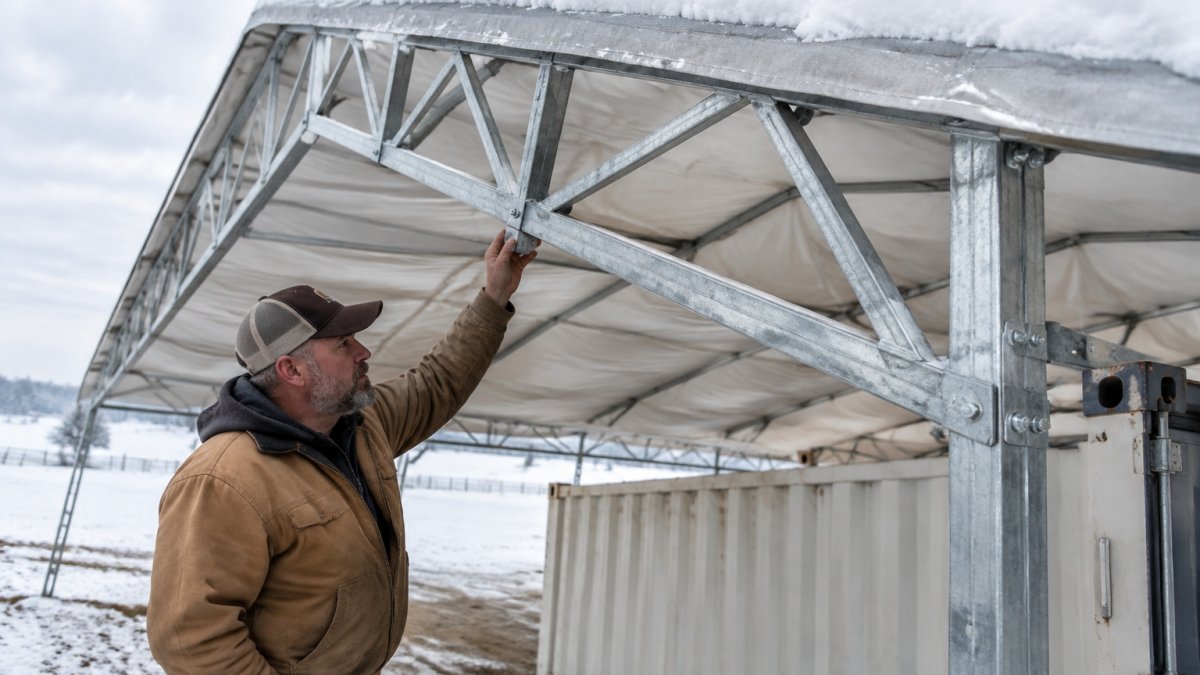
The 20' × 40' shelter uses hot-dip galvanized steel tubing, which helps protect the structural tubing against rust and corrosion.
The 40' × 40' × 15' Double Truss Peak Container Canopy Shelter uses a heavy-duty 22 oz PVC fabric cover, and the 20' × 40' shelter is available with a PE or PVC covering.
Our 20' × 40' Double-Truss Container Shelter comes with a choice of PE or PVC cover. The shelter uses hot-dip galvanized steel tubing and a pipe-and-ratchet tensioning system, and it is designed to mount between compatible shipping containers.
For a deeper comparison of frame types, see our guide to single-truss vs double-truss arch storage shelters before you settle on a design.
Shipping Container Compatibility and Mounting Methods
A container shelter is only as strong as the containers that hold it. The containers serve as elevated supports, so they must be properly positioned and secured. Confirm with your supplier that the containers you plan to use are compatible with the shelter's mounting system.
The shelter in our 20' × 40' model mounts along the inner edges of compatible containers using twist-lock and clamp connections. The frame is designed for eight-foot arch spacing across the 40-foot length. Shipping containers and front or rear wall panels are not included, and optional end panels are available separately.
Installation quality decides how the load travels into the containers. Loose clamps or uneven spacing can concentrate stress at a few points. Follow the manufacturer's instructions closely, and have the frame checked after the first heavy snow.
The manufacturer estimates about two days of assembly with a four-person crew for the 20' × 40' shelter.
40ft Shipping Container Canopy Options and Sizing for Snow Country
Size affects snow performance. A wider span means more roof area to carry snow and a longer beam to bend. Height affects wind exposure and how snow slides off. Choose the size that fits your equipment and livestock needs without overbuilding for space you will not use.
Our 60' × 40' double-truss shelters offer approximately 2,400 square feet of covered space, with a 20-foot or 15-foot canopy height.
For a wide shelter, you can also review our 60' × 40' × 15' Double-Truss Container Canopy Shelter as a lower-height alternative. A 40' × 40' double truss peak model provides about 1,600 square feet with a 15-foot peak height and a 22 oz PVC cover, which suits farms and contractors who need substantial covered storage without a traditional building.

Container Shelter Panels for Heavy Snow Price and Used Panel Considerations
Price should follow from the specifications, not replace them. Compare quotes on the same basis: frame type, steel coating, fabric weight and snow rating.
Current list prices for our container canopy shelters range from $4,599.00 for the 20' × 40' shelter to $11,999.00 for the 60' × 40' × 15' model. The 40' × 40' × 15' double truss peak shelter is listed at $7,899.00.
Used container shelter panels for heavy snow can reduce upfront cost, but they carry risks. Our guide to metal building insulation for winter explains the insulation and winter performance factors to weigh alongside price. A used panel may have fatigue, corrosion or fabric damage that is not visible from a quick inspection. Ask whether the panel's snow rating is documented, and have a qualified person inspect any used component before you install it over people, animals or equipment.
Ask for a clear written quote for project planning before you commit.
Current list prices for the container canopy shelters mentioned in the article are summarised below.
| Shelter | List price | Note |
|---|---|---|
| 20' × 40' shelter | $4,599.00 | Lowest listed price |
| 40' × 40' × 15' double truss peak | $7,899.00 | 22 oz PVC cover |
| 60' × 40' × 15' model | $11,999.00 | Highest listed price |
List price
Booking Your Heavy-Snow Shelter Quote With Flint Hills Barns
Snow season arrives quickly, so plan your shelter before the first storm. Flint Hills Barns is a veteran-owned business that provides personalized quote assistance from Bobby Payne, and we can confirm ZIP-code specific availability.
Our team provides clear written quotes you can use for project planning.
Request personal quote help from Flint Hills Barns to start planning a shelter sized and rated for your winter.
Frequently Asked Questions
How much snow can a container shelter handle?
The answer depends on the design snow load the shelter was engineered for, not on the container itself. Our double-truss frames use two structural members across the span, and hot-dip galvanized steel tubing helps protect against rust and corrosion. Ask the manufacturer for the snow load rating in pounds per square foot and confirm it matches the design load for your county. Heavy, wet snow is a much greater load than dry powder, so plan for the worst case your area sees.
How much does a heavy-snow container shelter kit cost?
Flint Hills Barns lists its container canopy shelters at $4,599.00 for the 20' x 40' double-truss model with a PE or PVC cover, $7,899.00 for the 40' x 40' x 15' double-truss peak model with a heavy 22 oz PVC cover, $11,599.00 for the 60' x 40' x 20' model and $11,999.00 for the 60' x 40' x 15' model. Shipping containers are not included in these prices, so budget for them separately. Ask for a clear written quote for project planning.
Do container shelter panels need to be cleared of snow?
Yes, you should clear heavy accumulations from the roof fabric to reduce the load the frame carries.
Can I buy used container shelter panels for heavy snow?
Used panels can save money, but they require careful inspection before you rely on them in heavy snow country.
