

Quick Summary
High-cube shipping containers add about a foot of interior height over standard units, letting farms store cabs, augers and tall shelving without losing floor space. They also resist weather and theft as sealed, lockable steel boxes that need little upkeep. Ventilation and condensation control are needed for temperature-sensitive loads.
- Measure your tallest item first, because a high-cube adds roughly 10 to 12 inches of interior height.
- Add 12 to 18 inches of clearance on each side of your largest item for access.
- Check floor loading for heavy concentrated loads and confirm stacking ratings before stacking containers.
- Install cross-flow vents, with a low inlet and high outlet, and screen them against rodents and wasps.
- Buy a padlock separately, because the container is not sold with one.
Table of Contents
- Why Farms Are Turning to High-Cube Shipping Containers
- High-Cube vs Standard Shipping Container: Which Fits Your Farm Loads
- 40-Foot High-Cube Shipping Container Dimensions and Usable Space
- Protecting Equipment, Tools and Supplies From Weather and Theft
- Ventilation for Farm Storage: Managing Airflow and Temperature
- Preventing Condensation Inside a Farm Shipping Container
- Planning Your High-Cube Container Purchase and Next Step
- Frequently Asked Questions
Why Farms Are Turning to High-Cube Shipping Containers
Last Updated: November 8, 2026
Farm storage has a space problem. Tractors, implements, bagged feed, fuel containers and seasonal supplies all compete for the same few square feet of barn floor. High-cube shipping containers offer a practical answer, and more farmers and ranchers across the Midwest and South are adding them to their properties. The appeal is straightforward: a sealed, lockable steel box that can sit on a gravel pad for decades with little upkeep.
The advantages of high-cube shipping containers for farm storage come down to three things: extra height, durability and security. Standard containers already protect contents from wind, rain and rodents. The high-cube version adds roughly a foot of interior height, which changes what you can store and how you organize it.
Many farms start with one container and add more as needs grow. A common approach is to use the first unit for tools and supplies, then add a second for machinery or implements once the layout is clear.
High-Cube vs Standard Shipping Container: Which Fits Your Farm Loads
The decision comes down to three measurements: interior height, door opening, and payload, not exterior footprint. You can browse the full range of storage containers to compare these specs side by side. A standard 40-foot container is shorter than a 40-foot high-cube, which adds roughly a foot of height, and the high-cube has approximately 8.7 feet of internal height. That extra 10 to 12 inches of interior height is the entire advantage, and it does not add floor area.
Match the container to your tallest item first, then check weight. A tractor with a cab or a boom arm that stands 8 feet tall will not clear a standard container's door header, which is typically about 7.5 feet on a standard unit versus roughly 8.5 feet on a high-cube. If your tallest load is under 7.5 feet and you are not stacking pallets, a standard container usually fits and costs less.
Height is not the same as weight capacity. The listed payload for the Chery Industrial four-side-door unit is up to 43,519 pounds when used within applicable limits, but floor loading should be checked for concentrated loads. A pallet of bagged seed or a fuel tank puts load on a small footprint, so check the floor rating and spread heavy items over crossmembers or plywood.
Watch out: stacking loaded containers two high multiplies point loads on the ground and on the lower unit's roof; confirm the corner castings and site base are rated for it before you stack.
Access changes the math too. A single end door on a 40-foot high-cube means you unload front-to-back, which is slow for mixed loads. Multi-door units with side openings let you reach equipment without moving everything in front of it. Measure your largest item against the door opening height and width, not just the interior, because a tall load that fits inside can still fail to pass the header.
A practical check before you buy: list your five tallest and five heaviest items, add 12 to 18 inches of clearance above and beside each for access, and compare those numbers to the interior height, door opening, and payload of the unit you are considering. If the tallest item needs more than 8.5 feet of clear height, the high-cube is the only option in a standard steel container.
40-Foot High-Cube Shipping Container Dimensions and Usable Space
Usable space is always less than the raw figure, because wall ribs, door swing and aisle clearance all take room.
Here is a simple way to check fit before you buy:
- Measure your tallest and longest items, including attachments.
- Add 12 to 18 inches of clearance on each side for access.
- Confirm door opening height and width against your largest item.
- Leave room at the door end for loading without moving other gear.
A farmer in work clothes beside an open high-cube container, loading a tall piece of equipment through the side door, shows how this works in practice.
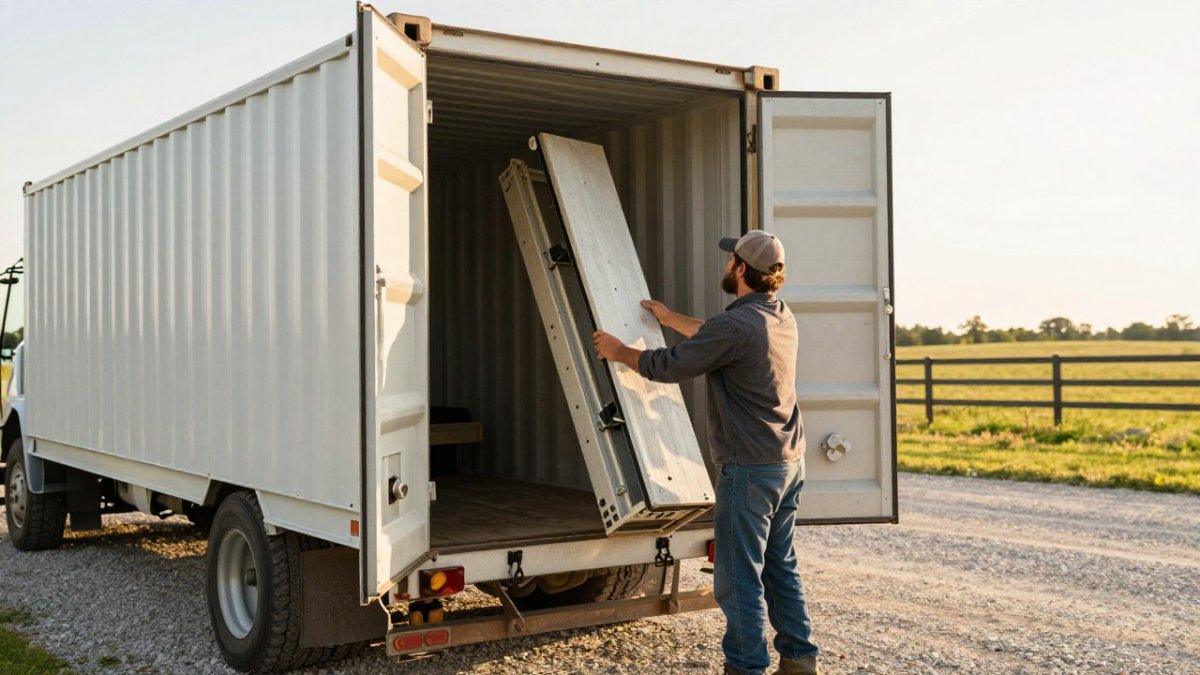
The Chery Industrial 40' High-Cube Container with Four Side Cargo Doors offers multiple access points along the container and approximately 8.8 feet of internal height. You can review it on the 40ft High Cube Container With 4 Side Doors listing. The 40' High-Cube Multi-Door Shipping and Storage Container, listed at $11,900.00, has two side-opening doors and one end-door opening.

The article's key container specs and clearance checks are summarised below for quick comparison.
| Item | Value | Note |
|---|---|---|
| Internal height (high-cube) | Approximately 8.8 feet | Chery Industrial 40' four-door unit |
| Clearance to add per side | 12 to 18 inches | For access around your largest item |
| Two-door unit price | $11,900.00 | 40' multi-door, two side doors and one end door |
| Padlock included | No | Padlock must be purchased separately |
Protecting Equipment, Tools and Supplies From Weather and Theft
Weather protection is one of the strongest arguments for a container. Corten weathering steel is built for corrosion resistance, and a sealed container helps keep rain and wind-blown dust away from stored goods. Contents stay drier than they would under a tarp.
Security matters just as much. A protected lock area helps shield the primary lock from weather and tampering. A lock box that shields the primary lock from weather and tampering adds another layer. Pair the container with a padlock, since a padlock is not listed as included with the container.
Weather protection still depends on maintenance. Doors, seals and roof panels need periodic checks to keep water out.
To add cover around a container for sun and rain, a Container Canopy can extend usable outdoor space near the unit.
Ventilation for Farm Storage: Managing Airflow and Temperature
A sealed steel container behaves like a greenhouse in summer. An open-sided canopy shelter alongside the container can add shade and airflow to help manage that heat. On a hot, sunny day, the interior of a sealed steel container can run noticeably hotter than the outside air because the steel roof absorbs heat. That heat matters for seed viability, feed quality, and any chemical with a temperature limit on its label. Ventilation is not a comfort feature on a farm container, it is a storage requirement for anything that can spoil, melt, or degrade.

The goal is cross-flow, not a single vent. Air needs an inlet low on one side and an outlet high on the opposite side so hot air can rise and escape while cooler air enters. Passive options include louvered side panels, roof vents, and vent cowls; a common pattern is two low vents on the shaded side and two high vents on the sunny side. Powered options such as a solar attic fan or a thermostatically controlled exhaust fan move more air when the sun is strongest. Position the container so the door faces prevailing summer breezes and avoid low spots where humid air pools.
Watch out: adding vents without screening them invites rodents and wasps; use hardware cloth or louvered covers, and keep the openings above the height where rain can blow in.
For sensitive loads, ventilation alone may not be enough. Seed, grain, and some fertilizers need stable humidity, and a bare steel container can swing from hot and dry by day to cool and damp at night. If you store chemicals, read the label for storage temperature ranges and keep them in a separate, ventilated area rather than sharing space with feed or seed.
Airflow also depends on how you load. Leave a gap between stored goods and the walls and roof so air can move, and avoid packing the container to the door. Aisles and pallets off the floor do more for air circulation than any single vent. Clean out spilled grain or feed before loading, because residue holds moisture and attracts pests.
Pair that with cross-flow vents and you have a workable system for most farm storage, but if your load is temperature-critical, plan for insulation and monitoring, not just a vent.
Preventing Condensation Inside a Farm Shipping Container
Condensation forms when warm, humid air meets cold steel. On cool nights the inside surface of the roof and walls can cool quickly, and water drips onto stored goods. This is a common complaint with metal storage, and it is easy to prevent if you plan for it.
Start by keeping the interior as dry as possible before you close the doors. Use moisture absorbers or desiccant packs near sensitive items. Lay down a moisture barrier or pallets to keep goods off the floor, which can hold dampness. Ventilation, covered earlier, reduces the moisture that builds up.
Planning Your High-Cube Container Purchase and Next Step
Before you buy, confirm three things: the interior dimensions against your largest items, the site preparation you need, and the total cost. A level, well-drained gravel pad is usually the foundation. Check local rules on placing a container on your land, since some counties and rural zones have requirements for accessory structures. Ask the seller about delivery and placement logistics.
Total cost goes beyond the container price. Factor in the pad, delivery, locks, ventilation, any canopy and periodic maintenance. A lower sticker price can cost more over time if it lacks the features your operation needs.
Flint Hills Barns can provide personalized quote assistance and clear written quotes for your property. Request personal quote help to talk through your needs and confirm availability before you commit. For a closer look at selection criteria, read our guide on How to Select a Container Shelter for Industrial Storage.
Frequently Asked Questions
Is a high-cube container worth the extra cost for farm storage? It usually is when you store tall equipment or stacked pallets. If your items fit comfortably in a standard container, the extra height adds cost without benefit.
How long does a shipping container last on a farm? Well-maintained weathering-steel containers can serve for decades. Regular checks on doors, seals and roof panels extend that life considerably.
Frequently Asked Questions
How much does a 40-foot high-cube shipping container cost?
A 40-foot high-cube container from Flint Hills Barns's catalog is listed at $10,999.00 for the four-side-door model and $11,900.00 for the two-side-door multi-door model. Both are one-trip containers with roughly 8.7 to 8.8 feet of interior height. Before buying, confirm whether delivery, site preparation and any add-ons are included in the quote, since those costs can change the total. Flint Hills Barns provides clear written quotes so you can compare the total cost.
What is the main difference between standard and high-cube shipping containers?
A high-cube container is roughly one foot taller than a standard container, which gives more vertical room for tall equipment, stacked pallets and machinery with raised implements. The floor footprint is the same. The extra height matters most when your loads do not fit under standard clearance. If your equipment fits comfortably in a standard container, the added cost of high-cube may not be justified for your use.
Do farm shipping containers need ventilation for storing feed or seed?
Yes, feed, seed and fertilizer are sensitive to moisture and temperature swings, so airflow matters. A sealed container can trap humidity, which encourages mold and caking. Adding vents or leaving doors cracked on dry days helps move air through the box. Keep products off the floor on pallets and avoid packing material against the walls so air can circulate.
How can you prevent condensation in a farm storage container?
Condensation forms when warm, humid air meets the cold steel walls and roof, then drips onto stored goods. Reduce it by keeping the container dry before loading, using desiccants or ventilation, and avoiding wet items or damp pallets. Inspect seals and door gaskets regularly, because worn seals let in moisture. Ventilating during daytime warm periods can also help balance the interior humidity.
