

Last Updated: November 4, 2026
Quick Summary
Corrugated steel roofs benefit Midwest garages by shedding snow before it piles into a load, tolerating freeze-thaw cycles without rot or splitting, and needing little upkeep since there are no granules to wear off or shingles to blow loose. Steel panels cost more up front than asphalt shingles but hold up better against hail, wind, and moisture.
- Snow load capacity depends on panel gauge, roof pitch, and truss spacing working together.
- Ask for the manufacturer's wind uplift rating before buying, since wind pulls roofs up.
- Condensation control needs a vapor barrier, insulation, and ventilation working together.
- Replace any fastener standing more than about 1/8 inch proud of the panel.
- Most practitioners specify self-drilling screws with bonded neoprene washers and about an inch of thread engagement.
Table of Contents
- Why Corrugated Steel Roofs Fit Midwest Garages
- Snow Load, Hail, and Wind Uplift: How Steel Holds Up
- Metal Roof vs Shingles Cost for a Garage
- Metal Building Insulation for Winter and Condensation Control
- Metal Roof Maintenance Tips for Freeze-Thaw Cycles
- DIY vs Professional Installation and Code Compliance
- Get a Written Quote for Your Garage Roof
- Frequently Asked Questions
Why Corrugated Steel Roofs Fit Midwest Garages
The benefits of corrugated steel roofs for Midwest garages start with one hard fact: this climate punishes every roof you put over a detached building. Snow sits for weeks, thaws, refreezes overnight, and hails in April. Rural property owners across the region often ask the same question every fall: what roof will still be sound after ten winters? Corrugated steel panels answer that better than most alternatives, and the reasons are structural, not cosmetic.
Corrugated steel roofing is a panelized roof system made from galvanized or Galvalume-coated steel sheets pressed into alternating ridges and valleys, which stiffen the panel and shed water and snow. The ribs do the load-bearing work that a flat sheet could not manage.
Three things make these panels a natural fit for a garage:
- Snow shedding: the slick, ribbed surface lets snow slide before it piles into a load.
- Freeze-thaw tolerance: steel does not absorb water, so it will not rot or split when moisture refreezes.
- Low upkeep: no granules to wear off, no shingles to blow loose in a spring gust.
That is the short answer. The rest of this guide covers what actually decides whether a steel roof performs on your building, from snow load to fastener spacing to code.
Snow Load, Hail, and Wind Uplift: How Steel Holds Up
Snow load capacity is the single number that matters most, and it depends on panel gauge, roof pitch, and truss spacing working together. A steeper roof pitch helps snow shed on its own; a shallow pitch holds it. Panel gauge sets how much weight the sheet carries between supports, and fastener spacing decides whether the whole assembly stays tied down when wind gets under an edge.
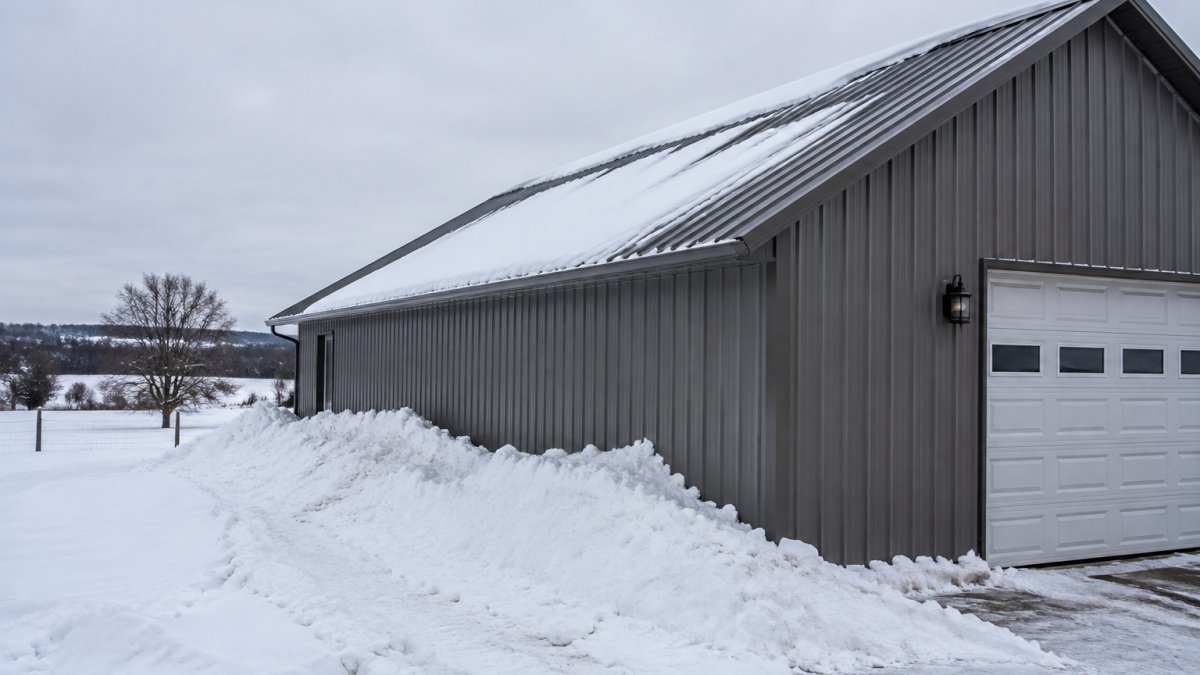
Hail resistance comes from the coating and the panel's stiffness. Galvanized steel carries a zinc layer that sacrifices itself to protect the base metal; Galvalume blends zinc and aluminum. Neither coating stops a dent from a serious stone, but both keep rust from starting where a dent does form.
Wind uplift is the failure nobody plans for. Wind does not push a roof down, it pulls it up by creating low pressure over the surface. Every fastener is a hold-down point, and spacing them too far apart is how panels peel off in a straight-line storm. Ask for the manufacturer's uplift rating before you buy.
For a broader look at how steel structures handle regional weather over decades, see our guide to metal structure durability in the Midwest.
Metal Roof vs Shingles Cost for a Garage
Metal roof vs shingles cost is not a single-number comparison, because the two products fail in different ways. Asphalt shingles generally cost less up front, while steel costs more at installation.
The trade-off is a higher initial outlay and the need for a competent installer who understands fastener spacing and sealant.
| Factor | Corrugated Steel | Asphalt Shingles |
|---|---|---|
| Upfront cost | Higher | Lower |
| Service life | Long, coating-dependent | Shorter, granule-dependent |
| Hail and wind | Dents but stays intact | Cracks, lifts, loses tabs |
| Freeze-thaw | Unaffected by moisture | Prone to edge damage |
| Maintenance | Occasional fastener check | Periodic patching |
| Fire rating | Noncombustible steel | Varies by product |
If you want to benchmark what a full workshop build runs, our metal workshop building cost breakdown walks through the line items.
Metal Building Insulation for Winter and Condensation Control
Condensation is the hidden problem in an unheated garage, and insulation is the fix most owners skip. Warm, moist air inside meets a cold steel panel, and water forms on the underside, then drips onto whatever is stored below. Over a winter that means rusted tools, damp feed, and a ceiling that rains on clear days.
Condensation control needs three things working together:
- A vapor barrier on the warm side to stop moisture reaching the cold panel.
- Insulation to keep the panel surface closer to interior temperature.
- Ventilation so any moisture that does get in can leave.
Steel sandwich panels can combine insulation with the panel itself. For a deeper treatment of winter performance, our metal building insulation for winter guide covers R-values and installation detail.
Metal Roof Maintenance Tips for Freeze-Thaw Cycles
Metal roof maintenance tips for a garage come down to a short annual checklist, because freeze-thaw cycles do their damage quietly. Water works into any gap, expands when it freezes, and widens that gap a little more each time. The weak link on a corrugated steel roof is almost never the panel, it is the fastener and the sealant around it.
Why freeze-thaw hits fasteners hardest. Steel expands and contracts with temperature far more than wood framing does. Across a Midwest winter, a panel can move measurably against its purlins every day the sun hits it and every night the temperature drops. That movement is transferred to the fastener, which rocks in its hole. Over several seasons the neoprene washer under the screw head compresses, cracks, or takes a set, and the seal is gone.
20' × 20' Galvanized-Steel Carport with Metal Roof →
What to inspect, and how.
- Walk the perimeter and every accessible run each fall, and check each fastener for backing out. A screw that stands proud of the panel by more than about 1/8 inch has lost tension and should be replaced, not just tightened.
- Look at the washer, not just the screw head. A washer that is cracked, flattened, or sunken into the panel has failed even if the screw is tight.
- Check sealant around fasteners, ridge caps, and pipe penetrations for cracks, shrinkage, or pull-away. Sealant in freeze-thaw country has a service life measured in years, not decades; plan to refresh it on a schedule rather than waiting for a leak.
- Clear gutters and the base of valleys so meltwater drains instead of pooling and refreezing at the panel edge.
- Check that no panel edge has lifted. A lifted edge lets wind start peeling, and peeling is how a roof loses panels in a straight-line storm.
- Remove debris and branches that hold moisture against the panels.
Fastener and sealant choices that survive cycling. Not all screws are equal in this climate. Most practitioners specify a self-drilling screw with a bonded neoprene washer and a coated or stainless head, sized to penetrate the purlin by the manufacturer's minimum, usually around an inch of thread engagement into the framing. Washers with an EPDM or neoprene compound hold up better to repeated compression than cheap foam or rubber washers.
Watch out: over-tightening a fastener deforms the washer and the panel around it, which creates a low spot where water sits and freezes, the exact failure the washer was meant to prevent. Drive screws until the washer just contacts the panel, not until the panel dimples.
Replace washers and reseal as needed before winter, not after. A fastener that has backed out a quarter inch is a leak waiting for the first freeze, and a leak that freezes at the panel edge can lift the lap and start a peel.
DIY vs Professional Installation and Code Compliance
DIY installation is possible on a simple garage, but code compliance and wind uplift are where most owner-builds get into trouble. A detached garage still needs a permit in most jurisdictions, and the inspector will look at fastener spacing, panel attachment, and load path.
What the code actually asks for. Local building codes set a ground snow load for each site, and the roof must be designed for that load plus the dead load of the panels and framing.
The inspection sequence. A typical permit inspection for a detached garage roof covers: footing and foundation, framing and truss attachment, sheathing or purlin installation, and final roofing. The final inspection is where fastener spacing, panel lap, and edge attachment get checked against the approved plans.
Honest DIY feasibility. A simple gable garage with a straightforward roof plane and good access is within reach of a careful owner-builder. The jobs that go wrong are the ones with valleys, dormers, skylights, or a low-slope section, and the ones where the owner underestimates the wind uplift requirement.
Where professional installation earns its cost. A competent installer brings the manufacturer's span tables, the right screw pattern for the local wind and snow load, and the sealant detail at laps and penetrations that keeps water out of the freeze-thaw cycle.
Fastener spacing is what holds a roof on in a storm, so it should follow the manufacturer's specifications. If you are weighing the two paths, our metal building permit process guide lays out the steps to stay compliant from the start.
The other thing nobody tells you: sealant has a service life. In freeze-thaw country, plan to inspect and refresh it on a schedule rather than waiting for a leak.
Get a Written Quote for Your Garage Roof
A written quote removes the guesswork, and that is where we come in. Flint Hills Barns is a veteran-owned business, and we help rural property owners, farmers, and ranchers get clear written quotes on custom metal structures, including garages, workshops, and carports. Bobby Payne works through your design and confirms ZIP-code specific availability through our regional manufacturing partnerships, so you know the building fits your land and your operation before you commit.
If you want covered protection without a full build, our 20' × 20' galvanized-steel carport with metal roof offers roughly 400 square feet of coverage on a hot-dip galvanized frame, available with corrugated color-steel sheets. You can also explore American Steel Carports through Flint Hills Barns & Buildings for personal help with design, regional availability, and a custom quote.

Frequently Asked Questions
What is the average lifespan of a corrugated steel roof in harsh climates?
Corrugated steel roof lifespan depends on the coating, installation, and conditions; ask the manufacturer for its published service life. In harsh climates with heavy snow and repeated freeze-thaw cycles, lifespan depends on panel gauge, sealant condition, and whether condensation is controlled from below. Steel carports from Flint Hills Barns carry a manufacturer-listed service life of up to 15 years,
Is a corrugated steel roof more cost-effective than asphalt shingles?
The metal roof vs shingles cost comparison usually favors shingles on day one, since architectural shingles carry a lower installed price per square foot. Steel costs more upfront. Request a written quote so you can compare total project cost rather than price per panel.
How does metal roofing handle heavy snow loads common in the Midwest?
Steel panels are often chosen for their snow-shedding surface. Snow load capacity still depends on roof pitch, panel gauge, purlin spacing, and truss design, so a detached garage needs its structure sized for local ground snow loads. Steeper roof pitch helps snow slide, while low-slope garages may need closer fastener spacing and heavier panels to meet structural integrity requirements.
What are the primary disadvantages of corrugated steel roofs for garages?
The main drawbacks are upfront cost, noise from rain and hail, and condensation on the underside of panels in unheated garages. Without a vapor barrier or insulation, warm moist air can condense on cold steel and drip onto vehicles and equipment. Fasteners and sealant washers also need periodic inspection, especially through freeze-thaw cycles. Most of these issues are manageable with proper underlayment, insulation, and a maintenance check each fall.
The roof over your garage has to survive everything the region throws at it, season after season. If you are ready to stop guessing and get a real number for your building, Flint Hills Barns can help. We provide personalized quote assistance, ZIP-code specific availability confirmation, and clear written quotes tailored to your land and daily operations. Get started with Flint Hills Barns and put a roof over your equipment that you will not have to think about again.
