

Last Updated: November 17, 2026
Quick Summary
Arch shelter anchoring uses auger screw anchors in firm soil, drive-in anchors in firm undisturbed ground, or concrete expansion anchors on a sound slab or footing. Choose the anchor type to match your base, then place anchors at each corner and along the base rails, closer together near the ends.
- Auger anchors are quick to install, reusable, and suit most natural soils.
- Drive-in anchors work well in firm ground but struggle in rocky or frozen soil.
- Concrete anchors give the strongest fixed base but need an existing slab or footing.
- Test-dig each corner of the footprint to check soil at depth before buying anchors.
- Re-check anchor tension after the first strong wind and after freeze-thaw cycles.
Table of Contents
- Anchoring Options Compared: Auger, Drive-In, and Concrete Anchors
- Choosing Ground Anchors for Your Soil and Site
- Shed Anchors for Concrete and Gravel Bases
- How Many Anchors You Need and Where to Place Them
- Heavy Duty Shed Anchors and Wind-Load Considerations
- Choosing a Metal Shed Anchor Kit and Planning Your Installation
- Frequently Asked Questions
Choosing the right arch shelter anchoring options is the difference between a structure that stays put and one that becomes a costly problem in the first strong windstorm. Flint Hills Barns, a veteran-owned builder serving farmers and ranchers across the Midwest and South, has seen how much rests on this decision. A large arch shelter is light for its size, and its curved profile catches wind. Without a secure connection to the ground, that combination can lift, shift or collapse a frame built to protect vehicles and machinery.
Solid arch shelter anchoring carries the load that the frame cannot, so the anchors deserve as much planning as the frame itself. A 30-foot-wide arch with a 15-foot peak presents a large surface for wind to push against, and the curved roof encourages air to slide over it and create uplift. Uplift, rather than sideways push, is often what pulls a structure off its footing.
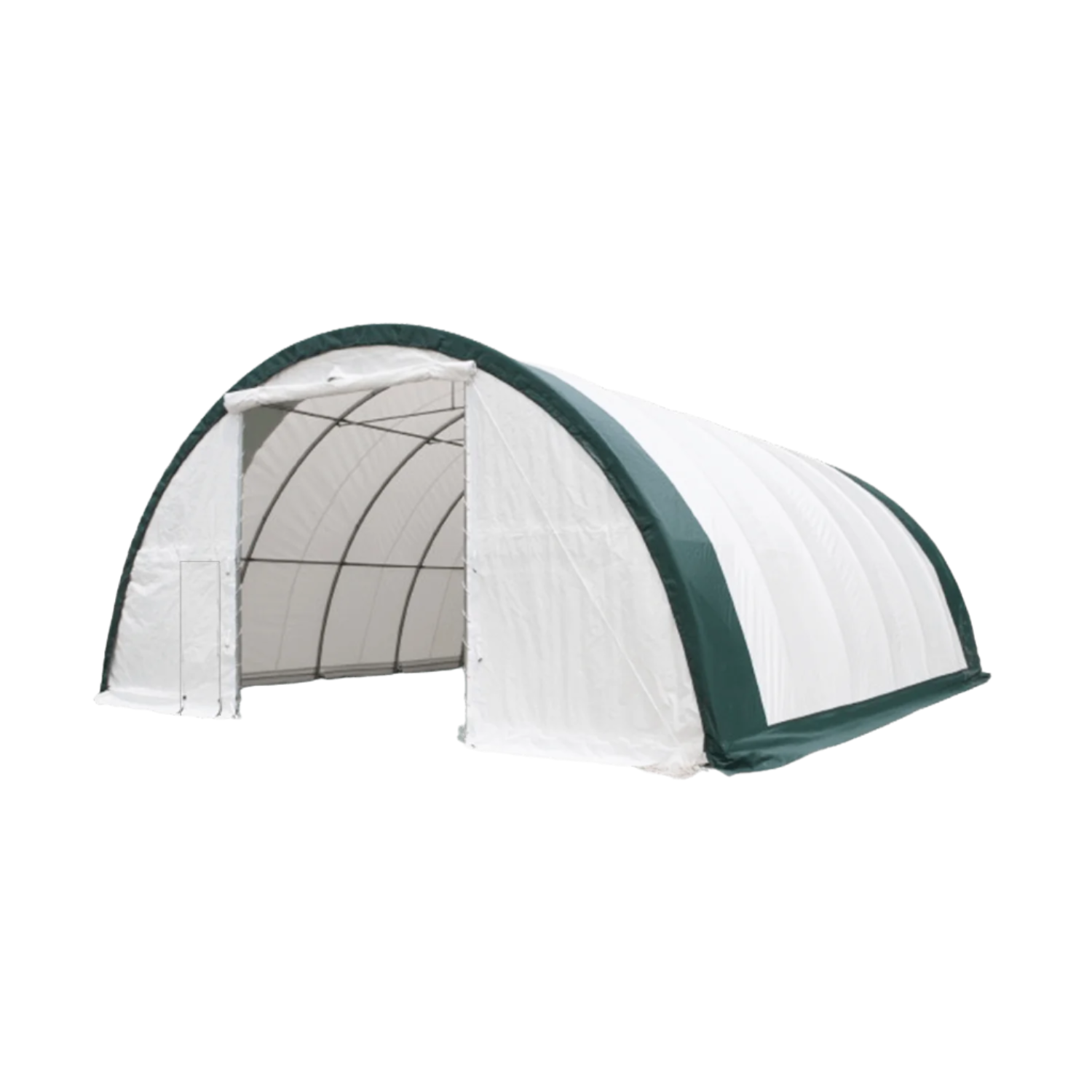
Anchoring also depends on what sits beneath the shelter. Bare soil, gravel and concrete each accept anchors differently, so the right approach changes with the site. The Gold Mountain 30' × 65' × 15' Single-Truss Arch Storage Shelter, for example, provides roughly 1,950 square feet of covered space for vehicles, equipment, and materials.
The sections below compare the main anchor types, explain how soil and base conditions affect your choice, and cover how many anchors to use and where to place them. Along the way, we will point out the mistakes that cause the most trouble.
Watch out: installing anchors into soft or loose ground and assuming the frame will hold. Shallow or poorly seated anchors often pull out in wind long before the frame itself fails.
Anchoring Options Compared: Auger, Drive-In, and Concrete Anchors
Three anchor families cover most large arch shelter installations: auger-style screw anchors, drive-in or arrowhead anchors, and concrete anchors. Each works in a different setting, and mixing them without a plan is a common source of failure.
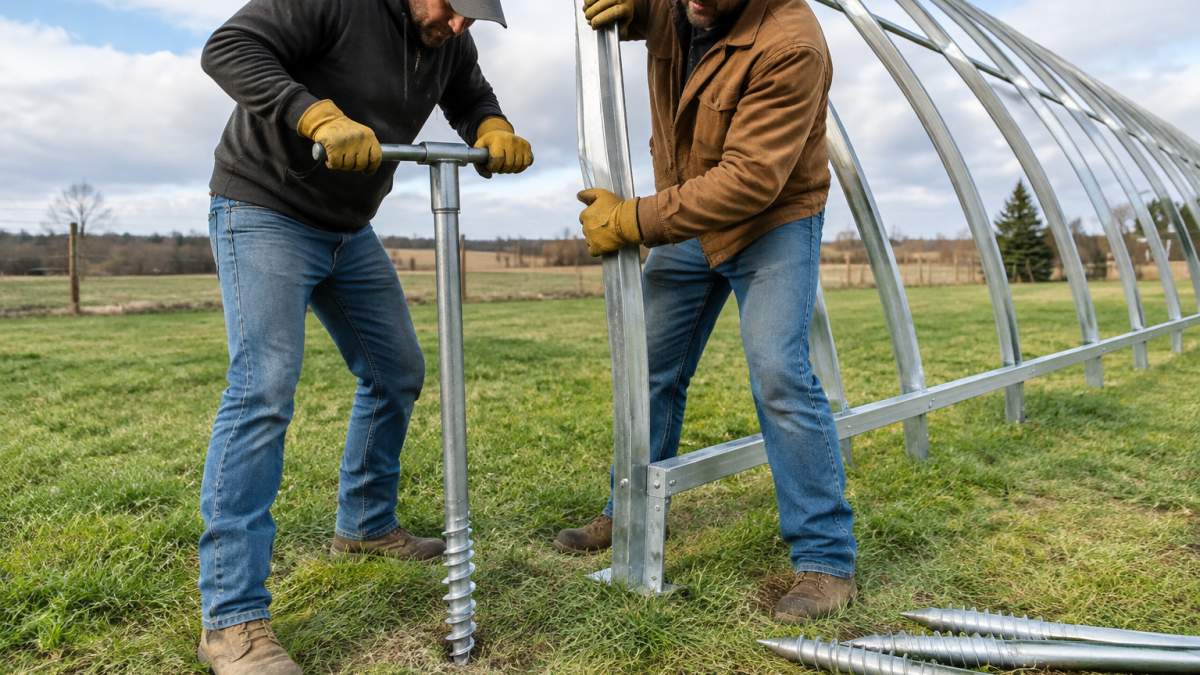
Auger anchors screw into the ground. Drive-in anchors are hammered or driven into the ground. Concrete anchors use expansion bolts or anchor rods set into a poured slab or footing.
Pros and cons of each anchoring method
- Auger (screw-in) ground anchors. Pros: quick to install with basic tools, can be removed and reused, and perform well in most natural soils. Cons: holding strength depends heavily on soil density, and they can loosen over time if not re-checked.
- Drive-in (arrowhead) anchors. Pros: fast to set and strong in firm ground. Cons: difficult to drive in rocky or frozen soil, and they offer less adjustment once set.
- Concrete anchors. Pros: the strongest option for a solid base, with dependable load capacity. Cons: they require an existing slab or footing, and installation is more labor-intensive.
The table below summarizes how these anchor types compare on the factors that matter most for a shelter of this size.
| Anchor type | Best base | Installation effort | Reusable | Typical role |
|---|---|---|---|---|
| Auger ground anchor | Firm soil | Low to moderate | Yes | Primary ground anchoring |
| Drive-in anchor | Firm, undisturbed soil | Low | Limited | Ground anchoring where soil is firm |
| Concrete expansion anchor | Poured slab or footing | Moderate to high | No | Secure fixed base |
Choosing Ground Anchors for Your Soil and Site
Soil type is the single biggest variable in how well a ground anchor holds, and most anchor failures trace back to a mismatch between the anchor and the ground beneath it. Our guide on preparing land for a steel garage covers site work that affects anchor performance.
Clay. Clay holds well when it is firm and dry, but it shrinks and swells with moisture and can lose grip after freeze-thaw cycles or heavy rain. In soft or saturated clay, plan for longer anchors or a different type entirely, because the threads may cut a smooth hole instead of biting.
Sand and gravel. Loose sand offers little lateral resistance, so auger anchors can pull out under uplift. Drive-in anchors with a wide arrowhead perform better in firm sand, and longer embedment helps reach denser layers.
Rocky ground. Drive-in anchors often hit refusal in rocky soil, and augers can bind or deflect. A test hole reveals whether rock is a shallow shelf or scattered stones. Where rock is close to the surface, concrete footings or a different base may be the practical answer.
Frost and groundwater. In cold regions, frost heave can lift anchors and loosen tension over winter, so anchors should be set below the local frost depth where practical. A high water table or seasonal saturation weakens soil grip, and anchors set in wet ground may need to be re-tensioned after the water recedes. Check the site after heavy rain, since saturated ground often weakens anchor grip temporarily.
A practical approach is to match anchor length and type to the soil you actually find, then confirm the anchor holds before committing to the full layout. If an anchor turns easily or pulls up with light force, the ground is not ready for that type. Treat soil assessment as the first step, not an optional one.
Shed Anchors for Concrete and Gravel Bases
Not every shelter sits on bare ground. Some owners set their structures on a concrete slab or a gravel pad. Each base requires a different anchoring method.
On concrete, expansion bolts and anchor plates are the standard approach. The anchor must be drilled to the correct depth and sized to the load. Concrete anchors perform reliably only when the slab is sound, cured and free of cracks near the anchor points.
Gravel bases need a different plan. Ground anchors can be driven or screwed through the gravel into the soil beneath, provided the gravel layer is not too deep. Review the foundation requirements for metal buildings on farms before choosing anchors. Where gravel is thick, the anchors may not reach firm ground, so check depth before purchase.
The Gold Mountain 30' × 85' × 15' Single-Truss Arch Storage Shelter with Dual Pull-Up Doors includes expansion-bolt anchoring hardware intended for installation on a compatible solid foundation. See the arch shelter sizes and structural options to compare configurations.
How Many Anchors You Need and Where to Place Them
Anchor quantity and spacing depend on the shelter's size, span, height, and the wind exposure at the site, and there is no single layout that fits every arch shelter. A 30-foot-wide arch with a 15-foot peak presents a different uplift profile than a 40-foot-wide double-truss shelter with a 21-foot peak, and a site on open ground takes more load than one sheltered by trees or buildings.
A practical method is to work from the manufacturer's anchor schedule first, then adjust for site conditions. Most arch shelter frames have pre-drilled anchor points at each frame leg or along a continuous base rail. Count those points, confirm the recommended anchor type for each, and treat that as the baseline.
As a general rule, place anchors at each corner and at intervals along the base rails, with closer spacing near the ends. On long shelters, intermediate frame legs or base-rail anchor points should be anchored as well, not just the four corners, because a long span can flex between corner anchors under gust loading. Confirm your final count and layout against the manufacturer's instructions for your specific model, since requirements vary by size and design.
Attachment matters as much as count. Anchors should connect to the frame through the base plate or base rail using the hardware the manufacturer specifies, and tie-down straps or tensioners should pull evenly so the frame is not twisted. Uneven tension can distort the arch and stress the cover, and a single loose anchor point can concentrate load on its neighbors.
Good placement also means keeping anchor points clear of obstructions and making sure each anchor can be tensioned evenly. Mark the layout before installation, check that each anchor seats fully, and re-check tension after the first strong wind and again after freeze-thaw cycles. If the site is exposed or the shelter is large, have a qualified engineer review the anchor count and spacing against local wind loads rather than relying on a generic rule of thumb.
Heavy Duty Shed Anchors and Wind-Load Considerations
Wind is the force that most often tests an anchoring plan. A large arch shelter presents a broad, curved surface, and wind moving over that surface creates both sideways push and upward uplift. Uplift is the more dangerous of the two for an arch, because it can lift the frame off its base.
Wind-load calculations for a specific site depend on local wind speeds, exposure and building geometry. Your local building department or a qualified engineer can supply site-specific values. The Gold Mountain 40' × 80' × 21' Double-Truss Storage Shelter with 8' Truss Spacing, with its reinforced double-truss frame, still needs an anchoring plan matched to the wind exposure at your location. Compare how single-truss and double-truss designs transfer loads to anchors.
Watch out: assuming a heavy frame is enough on its own. Weight alone does not resist uplift. Secure anchoring does.
Choosing a Metal Shed Anchor Kit and Planning Your Installation
Anchor kits bundle the hardware needed for a given shelter, and they can simplify ordering. Compare what each kit includes: anchor type, length, plates, straps and tensioning hardware. Confirm the kit matches your base, whether soil, gravel or concrete.
Plan the installation before the shelter arrives. Mark anchor locations, confirm soil or slab conditions, and gather the tools you need. Learn how to verify metal building delivery so you can check the components when they arrive. Work in dry weather if possible, and tension anchors evenly as you go.
After installation, check anchors periodically, especially after storms or freeze-thaw cycles. Re-tension straps and confirm no anchor has loosened.
For pricing, request a quote from Flint Hills Barns for your specific project. Request personal quote help from Flint Hills Barns to confirm the right anchor kit for your land, shelter size and base, and to check availability for your ZIP code.
Frequently Asked Questions
Does a storage shed need to be anchored?
Most large arch shelters should be anchored, especially when they are exposed to wind on open rural land. Anchoring keeps the frame from shifting and resists uplift when strong gusts get under the cover. Smaller, lighter structures may stay put with weight alone, but a 30-by-65-foot or larger shelter with a 15-foot peak catches far more wind. Check the manufacturer's installation instructions first, since they specify the anchoring hardware and foundation the shelter was designed for.
How many anchors does a large arch shelter need?
The number of anchors depends on the shelter's length, width, peak height, and your local wind exposure, so there is no single count that fits every building. Anchors are typically spaced along each base rail and at the corners and end walls, where uplift and lateral loads are highest. Ask the manufacturer for the anchor count and spacing listed for your model, and confirm it against your site's wind conditions before installing. Flint Hills Barns can help you review the layout for your specific shelter.
What anchors work best for a metal shelter on concrete?
Concrete expansion anchors and anchor bolts set into a solid concrete slab or footing typically work best for a metal shelter on concrete. Drill to the depth and diameter the anchor requires, clean the hole, and set the anchor to the torque the manufacturer specifies. Concrete must be fully cured and sound, and anchors should be kept clear of cracks and edges. Anchor plates and straps help spread the load across the base rail.
Can you anchor an arch shelter to gravel?
Auger-style or screw-in ground anchors are commonly used on gravel and bare ground, but gravel is loose and can shift, so anchor depth and holding strength may be less predictable. Driving anchors below the gravel into firmer soil improves hold. For the strongest option on a loose base, a poured concrete pad or footing is preferable. Confirm your base and anchor choice against the manufacturer's requirements before installing your Gold Mountain or Chery Industrial shelter.
