

Last Updated: November 4, 2026
Quick Summary
Portable restroom solutions for large farm operations are a sanitation plan built around crew size, fieldwork timing, and service truck access, not a scaled-up construction site order. Plan roughly one toilet per 10 workers on a standard shift, then add units for heat, shift overlap, and crews spread across multiple fields. Place units where both workers and the service truck can reach them in any weather.
- A 100-person crew needs roughly 10 units for a standard shift, adjusted upward for heat and shift overlap.
- Trailer-mounted units follow crews between fields, while stationary units suit anchored workforces like dairy operations.
- High-traffic units near the barn may need service twice a week during harvest; remote field units may hold a week.
- Compare providers by full-season total, since low monthly rates often recover margin on delivery and extra service calls.
- Decide which units stay live through winter before the first freeze, and get freeze-protection responsibility written into the contract.
Table of Contents
- Portable Restroom Solutions for Large Farm Operations: The Core Decision
- Types of Portable Sanitation Units and What Each Handles
- How Many Portable Toilets for 100 People on a Working Farm
- OSHA Sanitation Rules and Agricultural Hygiene Standards
- Farm Restroom Placement and Servicing Across a Large Site
- Long-Term Porta Potty Rental for Farms: What the Contract Should Cover
- Renting Versus Buying Portable Restrooms for Farms
- Waste Management, Winterization, and Safety Protocol Integration
- Frequently Asked Questions
Portable Restroom Solutions for Large Farm Operations: The Core Decision
Portable restroom solutions for large farm operations are not a scaled-up version of a construction site order. They are a sanitation plan built around crew size, fieldwork timing, and how often a service truck can physically reach the unit.
Sanitation planning follows the same logic as building placement, get placement and capacity wrong and the plan collapses.
Below, we'll show you exactly how to size units, place them, and write a contract that holds up through harvest.
What Makes Farm Sanitation Different From a Construction Site
Construction sites have a fixed footprint: crews arrive at the same gate and use the same unit for months. Farm operations spread people across hundreds of acres, and the crew changes with the season.
That mobility is the whole problem.
Three factors separate farm sanitation from a jobsite order:
- Distance: Workers may be spread across multiple fields on the same day.
- Seasonal spikes: Crew size can double during planting and harvest, then drop to a handful.
- Ground conditions: Soft soil, mud, and unimproved lanes limit where a heavy service truck can go.
The Occupational Safety and Health Administration treats field sanitation as a workplace requirement, not a convenience. That framing matters when you build the budget.
Types of Portable Sanitation Units and What Each Handles
Standard chemical units handle basic need and nothing more. Once you need handwashing, flushing toilets, or accessibility, the unit type changes, and so does the infrastructure it requires.
Here's how the main categories break down for agricultural use:
- Standard chemical units: Self-contained, no water or power hookup. Best for remote field locations and short-term spikes.
- Handwash stations: Standalone sinks paired with chemical units. Many operations pair one station per several toilets.
- Trailer-mounted restrooms: Multiple stalls on a towable chassis. Repositioned as crews move between fields.
If you want to browse the actual lineup, you can view our portable restrooms sanitation range to see which unit types are available to rent or buy.
Trailer-Mounted vs. Stationary Units
Mobility is the deciding factor. A trailer-mounted unit follows the crew; a stationary unit stays put and forces the crew to come to it.
Trailer-mounted units win when work moves weekly. They cost more upfront and need a tow vehicle and a level pad, but they solve the distance problem that sinks most farm sanitation plans.
Stationary units win when the workforce is anchored, a dairy operation with a fixed milking parlor has no reason to pay for wheels.
For large crews that need flushing toilets and sinks in one structure, the Bastone 2-Stall Portable Restroom with Flushing Toilets and Sinks provides two private restroom stalls. It requires a pressurized water supply and an approved wastewater arrangement, so plan the hookups before delivery.

How Many Portable Toilets for 100 People on a Working Farm
The working answer for 100 people is roughly 10 units for a standard shift, adjusted upward for heat, handwashing, and shift overlap.
The common planning ratio is one toilet per 10 workers on a standard shift. Increase the count when:
- Temperatures climb and workers drink more water
- Shifts overlap rather than run sequentially
- Handwash stations are separate units and need their own footprint
Unit capacity matters as much as count. Tell your provider the shift structure, not just the headcount.
Watch out: sizing by total headcount alone is the most common mistake we see. A 100-person crew split across three fields needs more units than 100 people working one barn.
OSHA Sanitation Rules and Agricultural Hygiene Standards
Field sanitation is addressed by OSHA's sanitation standard, which covers toilet facilities, handwashing, and drinking water for workers. Confirm the specific requirements for your crew size with the regulation itself.
Three practical points matter more than the regulation text:
- Access: Toilets must be reachable during the work shift, not a long walk away.
- Handwashing: Potable water and soap must be available where workers handle agricultural chemicals.
- Maintenance: Units must be serviced and kept sanitary, which means a real servicing schedule.
For operations that need accessibility built in, the Bastone 10-foot accessibility-oriented portable restroom includes a toilet, sink, and built-in shower, with a stainless-steel access ramp, ramp handrails, and an interior support rail beside the toilet.

Agricultural hygiene is not only a compliance box. Crews that can wash up between tasks are better positioned to manage hygiene on operations with livestock.
Farm Restroom Placement and Servicing Across a Large Site
Placement should follow the work, not the driveway. The best location is one a service truck can reach in any weather and a worker can reach in minutes.
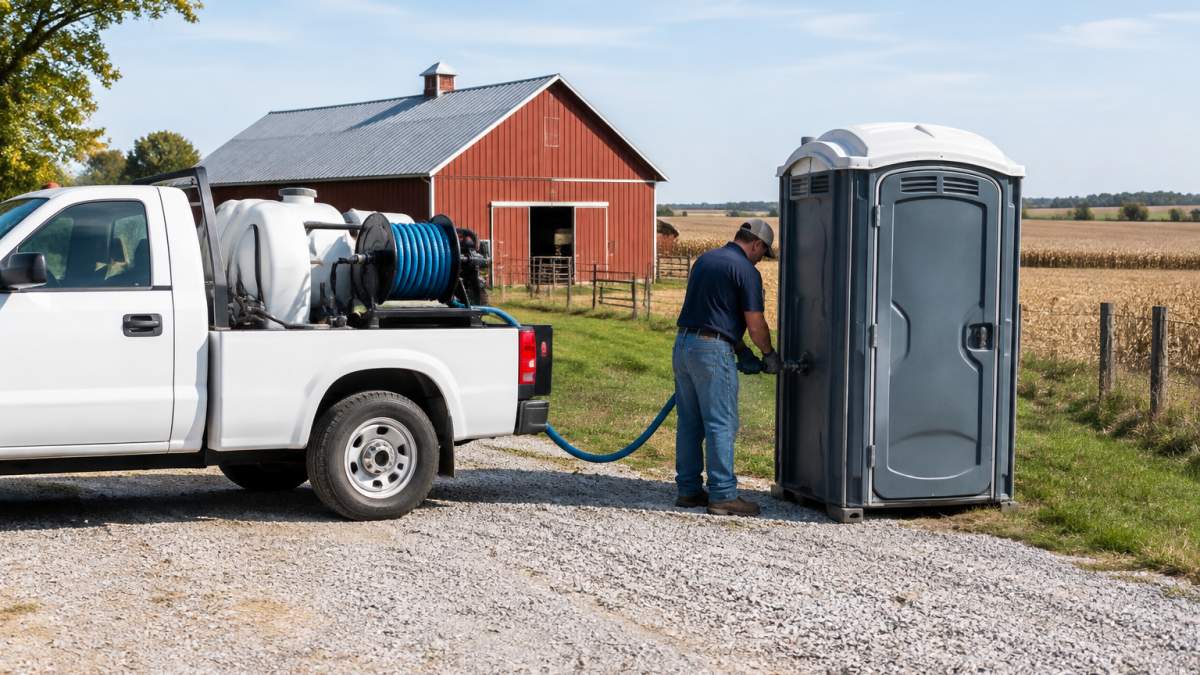
Plan servicing frequency around usage, not the calendar. High-traffic units near the barn may need service twice a week during harvest; remote field units may hold for a week.
Bastone 2-Stall Portable Restroom with Flushing Toilets and Sinks →
Site accessibility covers three things: a firm surface for the truck, enough turning room, and a route that stays passable after rain. Mud is the enemy of every sanitation schedule.
If you are also planning shelter and equipment placement on the same ground, our guide on portable container shelters for livestock covers layout considerations that apply to restroom placement too.
Long-Term Porta Potty Rental for Farms: What the Contract Should Cover
Long-term porta potty rental for farms should be priced as a service agreement, not a one-time drop. The monthly rate is only part of the cost, and on a large operation the servicing cadence, not the unit count, usually moves the full-season total.
Quotes for long-term sanitation rentals typically combine a monthly rental rate with servicing, delivery, and repositioning charges. Ask each provider which of these are included in its quote.
What Drives the Monthly Rate
- Servicing frequency. A unit pumped twice a week costs more per month than one pumped weekly, even at the same rental rate. Harvest-season units near the barn often need twice-weekly service; remote field units may hold a full week.
- Unit type. A standard chemical unit is the cheapest line item. A trailer-mounted multi-stall unit or a plumbed building with flushing toilets and sinks carries a higher rate because it has more fixtures, more water, and more service time per visit.
- Contract length. Seasonal contracts priced month-to-month usually carry a higher rate than a full-season commitment. If your season is predictable, ask for the season-length rate.
Build a Full-Season Total, Not a Monthly Comparison
The only fair comparison between two providers is the full-season total for the same scope. Ask each provider to quote:
- Number and type of units
- Servicing frequency per unit and what each visit includes
- Delivery, pickup, and any repositioning fees
Add those line items into one number per provider. A low monthly rate with a separate per-visit service charge can land well above a higher monthly rate that bundles servicing, especially on a 100-person crew where service visits stack up fast.
The Cost-Benefit Frame Most Operators Skip
The rental line is easy to see; the cost of getting sanitation wrong is not. Under-sizing units to save on the monthly rate often costs more in crew time lost to long walks or a unit that sits full because nobody scheduled the pump-out. Price the plan against crew time, not just the invoice.
Contract Terms to Get in Writing
- Servicing frequency and exactly what each visit includes
- Waste disposal responsibility and where the waste goes
- Repair and replacement terms for damaged units
Watch out: contracts that quote a low monthly rate often recover margin on delivery, pickup, and extra service calls. Ask for the full-season total and confirm in writing whether repositioning between fields is included or billed per move.
Renting Versus Buying Portable Restrooms for Farms
Buying makes sense when you need the unit year-round and have the infrastructure to support it. Renting makes sense when demand is seasonal or the site is temporary.
| Factor | Rent | Buy |
|---|---|---|
| Upfront cost | Low | Higher |
| Servicing | Included in contract | You arrange it |
| Mobility | Provider repositions | You move it |
| Best for | Seasonal crews, temporary fields | Year-round operations with hookups |
| Infrastructure | None required | Water, power, waste connections |
The break-even question is simple: how many months per year will the unit actually be in service?
Plumbed buildings generally need permanent hookups, water, power, and an approved wastewater arrangement before they can be placed into service.
Waste Management, Winterization, and Safety Protocol Integration
This is where most farm sanitation plans quietly fail, and it is the part of the plan the rental brochure never covers. Waste handling, cold-weather readiness, and safety integration are three separate operational systems that all have to be owned by someone on your side.
Waste Management and Disposal
Every chemical unit and every plumbed building holds waste that has to be pumped and hauled to an approved disposal site.
Three things to settle before the first unit arrives:
- Who pumps it. Confirm whether the provider's service visit includes pumping or whether pumping is a separate call. A service visit that only restocks paper and sanitizer is not a pump-out.
- Where it goes. The waste has to reach an approved disposal or treatment site. Ask the provider to name the disposal path in the contract so responsibility does not fall through the gap between you and the hauler.
- How often. Set the pump-out interval around usage, not the calendar. High-traffic units near the barn may need pumping twice a week during harvest; remote field units may hold a week.
Plumbed buildings add a second waste stream. A flushing unit needs an approved wastewater arrangement, a holding tank, a septic connection, or another permitted system, before it can be placed into service. That connection is your responsibility to arrange, not the rental provider's.
Winterization and Cold-Weather Readiness
Large farms operate year-round, and freezing temperatures are the most common cause of mid-winter sanitation failure.
Any unit with freshwater tanks, pumps, or flushing fixtures needs one of two treatments before the first hard freeze:
- Drain and winterize. Freshwater lines, pumps, and fixtures are drained and protected so they can sit unused through the cold months.
- Heat and protect. The unit stays in service with heated protection on the water system and a plan for keeping the supply line from freezing.
A common pattern is to keep chemical units in service through the winter for field crews and drain plumbed buildings until spring.
Watch out: winterization terms are often missing from a standard rental contract. If the agreement runs through cold months, get the freeze-protection responsibility, yours or the provider's, written into it.
Integrating Sanitation Into Farm Safety Protocols
Sanitation belongs in the daily safety brief, not in a separate binder. Crews should know three things at the start of every shift: where the units are, how to report a full or damaged unit, and who owns that report.
A workable protocol on a large operation looks like this:
- Name an owner. One person per crew or per field is responsible for the morning unit check and for calling in issues the same day.
- Post the locations. Unit locations go on the same field map the crew uses for equipment and shelter placement, so a worker new to a field can find the nearest unit without asking.
- Report the same day. A unit that sits unserviced for a week because nobody owned the report is the most common failure mode.
Preventative maintenance on your side is simple: check the unit each morning, report issues the same day, and keep the access lane clear.
Frequently Asked Questions
How many portable toilets do you need for 100 people?
A common planning baseline is one unit per 10 workers over a standard shift, so 100 people points to roughly 10 units. Split across multiple crews, that often means clusters of two to three units at each work zone rather than one central bank. Add units when shifts overlap, when the site is spread over several fields, or when handwash stations and ADA-accessible units are required. Confirm the count against the OSHA table for your crew size before you sign a rental contract.
Should farm operations rent or buy portable restrooms?
Rent when the need is seasonal and short, and buy when you need facilities year-round at a fixed location. Buying shifts cost from a monthly invoice to upfront capital plus servicing, water, and power. For a permanent site with a pressurized water supply and approved wastewater arrangement, a plumbed building such as the Bastone 2-stall unit at $5,600 is one option to consider. Run the math on your own servicing frequency and season length before deciding.
How often should portable toilets be serviced on a farm?
Weekly servicing is the usual baseline for a standard crew, with twice-weekly service during harvest or any period when unit capacity is stretched. Heat accelerates odor and waste volume, so summer schedules often tighten. Servicing covers pumping the holding tank, recharging deodorizing agents, restocking paper, and checking the unit for damage. Build servicing frequency into the rental contract in writing, and log each visit so you can spot units that fill faster than expected.
Do farm portable restrooms need handwashing stations?
Yes, where workers handle food crops, livestock, or chemicals, handwashing is a practical requirement; check the OSHA sanitation standard for the specific rules that apply to your operation. Self-contained units can pair with standalone handwash stations using freshwater tanks. Plumbed buildings include sinks, but they need a pressurized water supply and a gray-water outlet. Place wash stations at the same cluster as the toilets so workers do not have to walk between fields to clean up.
