

Table of Contents
- Understanding Metal Barn Siding for Your Agricultural Building
- Metal Barn Siding Types: Corrugated, Ribbed, and Panel Styles
- Galvanized vs. Galvalume Siding: Coating and Durability Explained
- Steel Gauge and Panel Thickness: What Matters for Your Barn
- Metal Siding for Barns Cost: Pricing, Value, and Total Ownership
- Metal Siding Installation Requirements and Setup Considerations
- Color, Finish Options, and Roofing Coordination
- Your Metal Siding Decision: A Step-by-Step Framework
- Frequently Asked Questions
Last Updated: October 10, 2026
Understanding Metal Barn Siding for Your Agricultural Building
Choosing metal siding for barns starts with understanding what makes metal the right choice for agricultural buildings.
Metal barn siding comes in several forms, each with distinct advantages. The most common options are corrugated panels, ribbed panels, and flat panels.
Metal siding can provide durable protection for agricultural buildings when the panel system, coating, and installation suit the site and use. Metal resists rot and pest damage, but corrosion, finish wear, impact, and weather performance depend on the selected product and its maintenance.
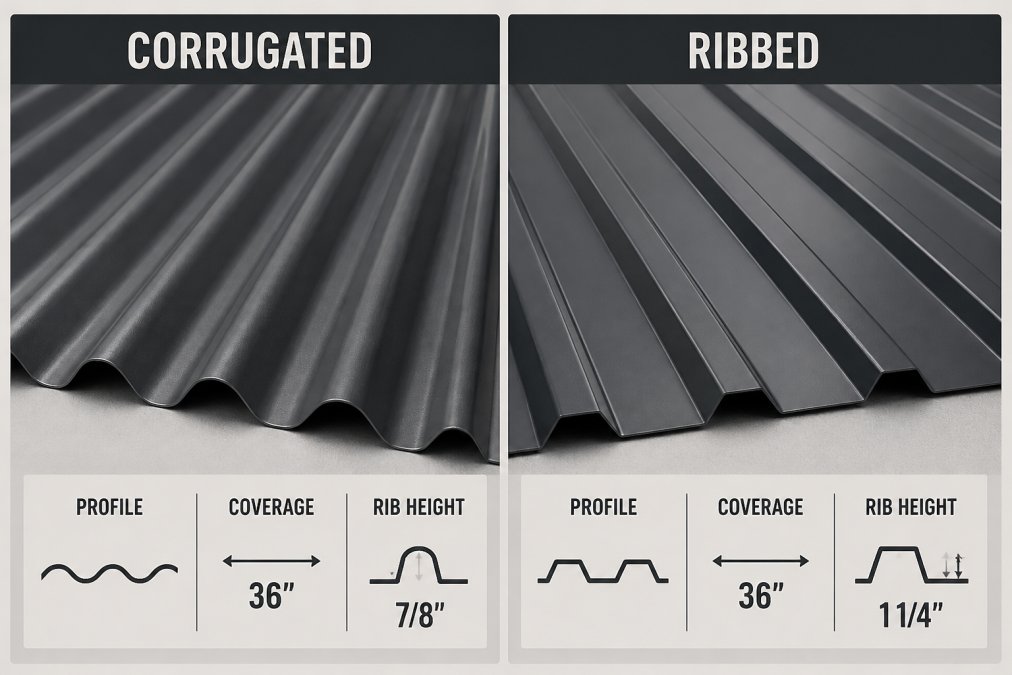
Metal Barn Siding Types: Corrugated, Ribbed, and Panel Styles
The profile you choose affects how your barn looks, performs, and costs over time. Corrugated and ribbed panels dominate the agricultural market for good reasons.
Corrugated Panels for Livestock Shelter and Storage
Corrugated metal panels feature a wavy, wave-like profile that runs vertically down the panel. This design has been the industry standard for barns and pole buildings for decades. The waves create strength without adding weight, making installation straightforward for most builders.
Corrugated panels are an option for straightforward storage and agricultural structures. Compare the selected panel's load tables, finish, and installation details rather than assuming every corrugated profile has the same impact or weather performance.
The main drawback is appearance. Corrugated panels look industrial. If your barn is visible from the road or near your home, you might prefer a cleaner look.
Ribbed Panels for Enhanced Rigidity and Impact Resistance
Ribbed panels use formed ribs that affect stiffness and appearance. Compare the specific profile's tested capacities, supporting structure, and installation requirements with the alternative panels under consideration.
Ribbed panels suit larger buildings where span distances are greater. They also look more refined than corrugated options. Many modern barns and equipment storage buildings use ribbed profiles for this reason.
Profile alone does not establish suitability for high winds or snow. Compare complete panel-system specifications and quotes for the actual building and site.
| Panel Type | Best For | Weather Resistance | Cost Level |
|---|---|---|---|
| Corrugated | Storage and agricultural uses, subject to product approval | Verify the selected system | Compare project quotes |
| Ribbed | Projects suited to the specified ribbed panel system | Verify the selected system | Compare project quotes |
| Flat | Modern aesthetics, low-profile look | Verify the selected system | Compare project quotes |
Galvanized vs. Galvalume Siding: Coating and Durability Explained
The coating on your metal panels matters as much as the profile. Two primary coating systems protect agricultural metal siding: galvanized and Galvalume.
Galvanized steel uses a zinc coating that helps protect the steel beneath it. Coating weight, finish, exposure, and maintenance affect performance; there is no single service life that applies to every barn.
Galvalume coating combines aluminum and zinc to protect steel. It performs well in many applications, but salt exposure and animal-confinement conditions can restrict its suitability and warranty. Check the exact product and exposure with the panel manufacturer.
Choose the coating for both the outdoor exposure and the conditions inside the building. For livestock housing, coastal properties, or chemical exposure, obtain the manufacturer's written recommendation and applicable warranty terms rather than assuming either coating is suitable.
Steel Gauge and Panel Thickness: What Matters for Your Barn
Steel gauge measures thickness. Lower gauge numbers mean thicker steel. Common gauges for barn siding are 29, 26, and 24.
29-gauge steel is thinner than the 26- and 24-gauge options discussed here. Use it only where the selected panel system and supporting structure meet the project requirements.
26-gauge steel is an intermediate thickness among these options. Compare its specified panel-system capacity and installed cost for your agricultural building.
24-gauge steel is thicker than 26- and 29-gauge steel. Thickness alone does not establish a wind or snow rating; the complete assembly must meet the project requirements.
Panel thickness can affect dent resistance, but a panel is not a substitute for appropriate protection from direct animal or equipment impact. Confirm the intended application and any protective details with the supplier.
Metal Siding for Barns Cost: Pricing, Value, and Total Ownership
Metal siding cost extends beyond the panel price. A complete budget includes materials, labor, fasteners, trim, and maintenance. Compare the same scope and realistic upkeep requirements when evaluating total ownership cost.
Material and Installation Cost Breakdown
Panel material is one part of installed cost. Request a line-item price for the selected profile, finish, quantity, and delivery instead of assuming a fixed share of the total.
Labor and installation prices depend on access, building details, and the panel system. Ask the installer to quote the required fastening and weather-sealing work separately.
Fasteners, trim, closure strips, and sealants also need to be included in the quote. Use accessories that the panel manufacturer approves as compatible with the panel, coating, supporting material, and exposure.
Maintenance and Lifecycle Costs
Follow the panel manufacturer's maintenance instructions. Inspect fasteners, finishes, sealants, trim, and drainage, and repair or replace deteriorated components as directed. Metal siding should not be treated as maintenance-free.
Repairs are straightforward and affordable. A dented panel can be replaced. A rusted fastener or trim joint can be sealed or replaced. Compare this to wood siding, where rot spreads and requires section replacement, or vinyl, which becomes brittle and cracks in cold climates.
Service life depends on the product, coating, exposure, installation, and maintenance. Review both the expected maintenance and the warranty exclusions for the proposed application.
Total Cost of Ownership Comparison
For a useful ownership-cost comparison, price the same building and scope in each material, then account for the maintenance and repair work each supplier recommends.
For wood siding, include the finish, inspection, and repair schedule recommended for the selected product and site.
For vinyl siding, compare the selected product's impact and wind performance, installation requirements, and warranty instead of assuming a fixed replacement age.
Metal siding can be a practical long-term option, but lifecycle value depends on the actual product, exposure, installation, and maintenance costs.
Metal Siding Installation Requirements and Setup Considerations
Installation quality determines how long your metal siding performs. Improper fastening, inadequate sealing, and poor trim work lead to leaks and panel failure. For agricultural buildings, interior conditions, moisture, ammonia, and wash-down, add complexity that standard installation practices must address.
Fasteners, Trim, and Weather Sealing
Use the fastener type, coating, washers, and installation details approved by the panel manufacturer. Compatibility matters: an unsuitable fastener or accessory can contribute to corrosion, leaks, or loss of performance.
Fastener placement and tightening must follow the panel manufacturer's instructions and the project details. Allow for the system's specified thermal movement and avoid damaged or incorrectly compressed sealing washers.
Trim work seals the edges where panels meet corners, roofing, and foundations. Quality trim prevents water from running behind panels where it causes rust and structural damage. Corners and transitions are where most leaks originate.
Agricultural-Specific Challenges: Condensation, Ammonia, and Interior Moisture
Livestock barns and equipment storage buildings face interior moisture and chemical exposure that standard barn siding must withstand.
Condensation and interior moisture are the primary threat in livestock facilities.
Mitigation requires proper ventilation design and underlayment.
Ammonia exposure from livestock urine and manure is corrosive to unprotected steel. Ammonia accelerates rust on galvanized coatings, especially in poorly ventilated facilities.
For livestock facilities, ask the panel manufacturer to confirm suitability for animal-waste exposure, ventilation, cleaning products, and wash-down conditions. Follow its specified coating, accessory, inspection, and repair requirements.
Wash-down and chemical exposure in equipment storage or milking parlors demand corrosion-resistant fasteners and sealed trim.
Regional Conditions: Coastal, High-Wind, Snow, and Corrosion
Coastal exposure needs a product-specific review. Salt spray can attack steel coatings, and Galvalume is not a blanket recommendation for coastal sites. Confirm the material, finish, compatible fasteners, maintenance, and warranty exclusions with the manufacturer.
For high-wind sites, use the approved panel system, supporting structure, and attachment details for the project's design loads. There is no universal gauge or fastener spacing that establishes suitability from wind speed alone.
For snow-prone sites, confirm the required roof design and loads with the building supplier and responsible designer. Do not assume a steep roof or a siding gauge removes the need to address snow accumulation and the complete structure.
Color, Finish Options, and Roofing Coordination
Metal panels come in dozens of colors. Common agricultural colors are red, green, tan, and silver. Modern barns also use charcoal, bronze, and white for a contemporary look.
Color choice affects temperature inside the building. Dark colors absorb heat. Light colors reflect heat. In hot climates, lighter colors reduce cooling costs.
Coordinate your siding color with roofing panels for visual continuity. Matching colors create a polished appearance. Contrasting colors emphasize the structure's lines.
Paint finish affects appearance and maintenance. Review the specific finish warranty, exposure exclusions, and care instructions rather than treating a warranty term as a guaranteed service life. Coastal applications require manufacturer confirmation for the selected material and finish.
Your Metal Siding Decision: A Step-by-Step Framework
Choosing metal siding for barns follows a logical sequence. Start with your building's purpose and regional climate.
Step 1: Identify your building type. Livestock shelter, equipment storage, workshop, or mixed-use? Record the intended use and interior conditions before comparing panel systems.
Step 2: Check your exposure. Identify the project's wind and snow requirements, coastal salt exposure, and interior livestock or chemical conditions.
Step 4: Choose your coating. Use the manufacturer's recommendation for the actual exposure and intended use, and review warranty exclusions.
Step 5: Pick your profile. Compare appearance, installed cost, and the specified performance of the actual panel systems.
Step 6: Get a detailed quote. Contact Flint Hills Barns for personalized assistance.
Frequently Asked Questions
What's the best metal siding for a barn that needs to protect livestock and equipment?
The best choice depends on the building, site, and intended use. For livestock shelters, confirm that the coating and complete panel system are suitable for animal-confinement conditions. Coastal exposures also need manufacturer review. Do not choose gauge or profile from a general rule; match the approved system to the project requirements and ask for a written specification.
How do galvanized and Galvalume siding differ in cost and durability?
Galvanized siding uses a zinc coating, while Galvalume uses an aluminum-zinc coating. Cost and durability depend on the product, finish, exposure, and maintenance. Galvalume is not a blanket choice for coastal sites or animal confinement. Obtain the manufacturer's recommendation and compare current quotes and warranty terms for the intended use.
What steel gauge should I choose for my barn, and does it affect the total cost?
Common options include 29-, 26-, and 24-gauge steel; lower gauge numbers mean thicker steel. Thickness can affect cost and stiffness, but it does not by itself determine the wind or snow performance of a building. Choose the specified panel system, supports, and fastening details for the project rather than relying on a gauge-only rule.
What are the main installation requirements for metal barn siding?
Metal siding requires compatible fasteners, trim, and weather sealing installed to the selected system's instructions. Confirm the project-specific attachment details and any required engineering. Coastal salt spray, livestock exposure, wind, snow, and freeze-thaw conditions can affect system selection and maintenance. Obtain the written specifications before installation.
Metal siding for barns is a major investment that protects your livestock, equipment, and machinery for decades. The right choice depends on your building's purpose, your climate, and your budget. Flint Hills Barns simplifies this decision with personalized guidance tailored to your region and operations. Request a personal quote from Bobby Payne today to see how we customize solutions for animal shelter, equipment storage, and agricultural buildings that fit your land and your needs.